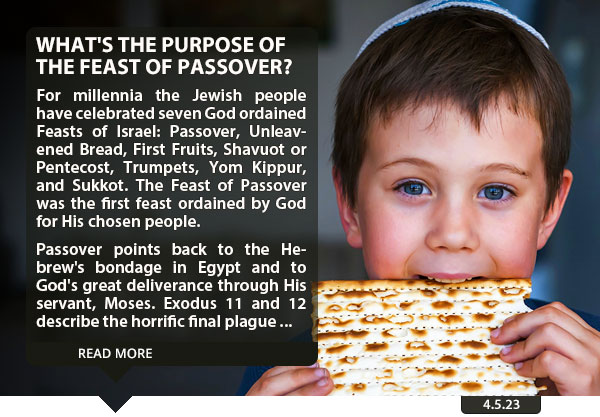
Tim Moore: For millennia the Jewish people have celebrated seven God-ordained Feasts of Israel: Passover, Unleavened Bread, First Fruits, Shavuot or Pentecost, Trumpets, Yom Kippur, and Sukkot. With Passover upon us, this week's episode of Christ in Prophecy will examine the feast that originally marked the beginning of the Jewish year.
Nathan Jones: The Feast of Passover was the first feast ordained by God for His chosen people. Passover points back to the Hebrew's bondage in Egypt and to God's great deliverance through His servant, Moses. Exodus 11 and 12 describe the horrific final plague that had struck the Egyptians and God's provision for preserving His people while the firstborn throughout the land were being killed by the Angel of Death.
When it comes to the Feast of Passover, in Exodus 13:10, the Lord commanded, "You shall keep this ordinance at its appointed time from year to year." The Jewish people have done just that for nearly 3,500 years!
Tim Moore: The prophetic significance of Passover is so obvious that even the spiritually undiscerning see its implications to the Christian faith. Aside from a vision of the scene offered by Cecil B. DeMille's movie, The Ten Commandments, many Christians are still unaware of the significance and beauty of the Feast of Passover and how it offers insight to those with spiritual eyes to see.
In order to peel back some of the mystery and expound on the beauty and prophetic implications of this feast, we've asked Dr. Richard Hill, a "Jew born anew" and the Messianic pastor of Beth Yeshua Messianic Congregation, to teach us.
Elements of the First Passover
Richard Hill: I am going to teach you about Pesach, which is the Hebrew name for Passover.
Let's go to Exodus 12 and look at the first 14 verses. Here we find the Lord speaking to Moses and Aaron while they are attempting to free the captives from the land of Egypt.
Verses one and two: "Now the Lord said to Moses and Aaron in the land of Egypt. This month shall be the beginning of months for you. It is to be the first month of the year to you." While in Egypt, the Hebrews had been following the Egyptian calendar, but now God has decided to begin a new Hebrew calendar. This is now the beginning of a new year for the Jewish people.
Verse three reads: "Speak to all the congregation of Israel saying on the tenth of this month [the tenth of Nisan] they are to each one take a lamb for themselves according to their father's household, a lamb for each household." The Hebrew word here is śeh and it means "kid". So, they could take a lamb, but they could also take a goat.
Verse four reads, "Now, if the household is too small for a lamb, then he and his neighbor nearest to his house are to take one according to the number of persons in them, according to what each man should eat, you are to divide the lamb." So, each household had a lamb, but if you didn't have enough people in your family, you had to invite your neighbor or another household close by to come over to your house and eat this lamb or goat together. The rabbis determined that for every lamb that is slain you are supposed to have at least 10 to 20 people. The lamb feeds a lot of people!
The lamb shall be a one year old lamb, for as verse five states, "Your lamb shall be an unblemished male, a year old; you may take of it from the sheep or from the goats." Imagine Jewish people eating goat for Passover! None of us do really. The Jewish people always ate lamb, but we don't anymore, not since 70 AD when the Temple was destroyed. The rabbis determined from that time on that you are not allowed to eat a Passover lamb because you couldn't sacrifice it in the Temple. So, today, we substitute other meats such as brisket, chicken, and turkey. Different parts of the world eat different meats.
Verse six commands, "And you shall keep it until the fourteenth day of the same month when the whole assembly of the congregation of Israel is to kill it at twilight." The families kept their poor little lamb for four days. Well, what about the children? What's going on in their minds? They are becoming attached to that little lamb. Isn't that the point, though? We become attached to the Passover lamb, better understanding how that little lamb is going to die for our redemption. I think the Lord wanted us to become attached to better understand what this death really was going to mean to that household.
Verse seven orders, "Moreover, they shall take some of the blood and put it on the two doorposts on the lintel of the houses in which they eat." They would slit the lamb right on the jugular vein so that the lamb dies instantly. There was to be no suffering whatsoever. That's a kosher thing within Judaism. You're not allowed to let the animal suffer.
The families would then take a bowl and collect the blood. And, what were they to do with the blood? They painted the blood on their doorpost, particularly the lintel which is the upper-middle portion, then along the left and right sides. What sign is that? If you just paint a little bit up top, a little bit on one side, and a little bit on the other side, you make the sign of the cross. That's what I teach the Christians.
What do I teach the Jewish people? Imagine being a Jewish person at that time and learning that God said, "I want you to paint the blood on the doorpost." Being Jewish, I'm thinking: "I'm going to paint my whole house! I don't want the Angel of Death to not see the blood that's covering my household." But, you just needed to go across the whole lintel, down one whole side, and then down the other side. This shape in Hebrew is called the chai. The first letter is a chet and chai means "life" — l'chaim — "to live". And so, when you put the blood on the doorpost of your house, then you are going to have life; you're not going to have death.
Verse eight continues, "They shall eat the flesh that same night, roasted with fire, and they shall eat it with unleavened bread and bitter herbs." All of the meat needed to be roasted by fire, so there's no boiling it in water or anything like that.
Here's where the unleavened bread comes in. Passover runs the whole day and then you eat the Passover meal at night. That first night serves then as the first night of the Feast of Unleavened Bread. God says to eat unleavened bread, but also, bitter herbs. Rabbi Gamaliel from the New Testament was Paul's rabbi. He's the one who said at that time on the Feast of Passover every Jewish person needs to talk about at least three things: the Passover lamb, the unleavened bread, and the bitter herbs.
Verses nine and ten read: "Do not eat any of it raw or boiled at all with water," which we explained, "but rather roast it with fire, both its head and its legs along with its entrails. And you shall not leave any of it over until morning, but whatever is left of it until morning you shall burn it with fire." So, there should remain nothing left of the animal. All of it would be destroyed. It's a done deal. God's grace is sufficient.
Verse eleven adds, "You shall eat it in this manner: with your loins girded, your sandals on your feet, and your staff in your hand: and you shall eat it in haste — it is the Lord's Passover." They were to eat in haste because the Jews of the Exodus were getting ready to leave as quickly as possible. Now, we know they didn't leave right away, but God wanted them just to be ready to go at a moment's notice.
Of course, today we do not celebrate Passover that speedily anymore. We are not killing lambs and putting their blood on our doorposts. Nor are we girding our robes into our waistbands.
The proper way to eat the Passover meal is to sit reclined at the table, and we still sit that way reclining. Jesus at the Passover would have used a smaller table than what we see in DiVinci's famous painting "The Last Supper," and they would have reclined on pillows on the ground.
The bread wasn't as high as DiVinci depicted either, for the bread would have been very thin, as it was unleavened bread. Leaven is the yeast that makes bread rise. The Hebrews of the Exodus didn't put yeast in their bread because they had to cook their bread and get out of Egypt as fast as possible. We see that right in verse 11 where it says that they're going to eat it in haste and so weren't able to take the time to put leaven in their bread.
God reveals his plans for the Egyptian slavers in verse twelve, "For I will go through the land of Egypt on that night and I will strike down all the firstborn in the land of Egypt, both man and beast; and against all the gods of Egypt, I will execute judgments — I am the Lord." God's punishment struck upon the Egyptians and Pharaoh and against all of their false gods. The ten plagues were in fact judgments against the Egyptian gods. Yahweh took their worthless gods to task thereby demonstrating that Yahweh is God alone. Yahweh stands apart as the one and only God.
Verse thirteen promises, "And the blood shall be a sign for you on the houses where you live; when I see the blood, I will pass over you..." That's where we get the Hebrew word pesach, for in Hebrew it means "passing over you." And, when the Angel of Death passes over the blood-protected houses, "no plague will befall you to destroy you when I strike the land of Egypt."
Ongoing Celebration of the Passover
Verse fourteen gives God's command for the Jewish people to continue the Feast of Passover: "Now, this day will be memorial to you, and you shall celebrate it as a feast to the Lord; throughout your generations you are to celebrate it as a permanent ordinance." The Jewish people were to continue, even to this day and into the future, to celebrate Passover. By doing so, they will remember what God has achieved in providing the miraculous deliverance of His people out of the land of sin — out of the land of Egypt — and by bringing them into the land of Israel.
I know of no other religious ceremony that has been celebrated as long as the Passover has been celebrated.
The true Passover Lamb will be revealed! Watch the full episode of Christ in Prophecy or read the blog series to learn Who.
|