

When was the doctrine of the Pre-Tribulation Rapture first taught? Find out with guest Lee Brainard and evangelists Tim Moore and Nathan Jones on the television program, Christ in Prophecy!
Air Date: July 18, 2026
Video Links
Soothkeep with Lee Brainard
Resource
To order, call 1-972-736-3567, or select the resource below to order online.



Transcript
Tim Moore: Hello again and welcome back to Christ in Prophecy! Last week we examined the idea of Christian Zionism and discovered that it is an idea as old as the New Testament.
Nathan Jones: Not many Gentile Christians walk around thinking of themselves as Christian Zionists, but if we take God at His Word, then we will want to love those He loves and bless those He has promised to bless.
Tim Moore: Clearly God told Abraham that He would bless the nations and peoples who blessed him and his descendants. The same promise was reiterated to Isaac and Jacob, and for the past 4,000 years, that prophetic promise has been true. Those nations that blessed Israel were blessed, and those that cursed Israel, even if they were serving the purposes of God to discipline His chosen people, were inevitably cursed.
Nathan Jones: Satan has perpetuated a very long and successful propaganda campaign to discredit the Jewish people and inspire antisemitism in the Gentile nations. Tragically, even Christians have been swept up into this grand deception.
Tim Moore: So today we’re going to turn our attention to another myth that has plagued the Church in recent years in particular, the idea that the promise of Jesus coming for His bride, the Church, prior to the Tribulation is too new to be true. In fact, faithful Christians have longed for the imminent fulfillment of that promise for 2,000 years.
Interview with Lee Brainard
Tim Moore: And joining us again today to discuss this important and timely topic is Lee Brainard, a good friend of Lamb & Lime Ministries and a recognized expert in Greek and Aramaic and probably other languages as well. Lee, welcome again back to Christ in Prophecy.
Lee Brainard: Glad to be with you, Tim. And Nathan.
Nathan Jones: Alright, Lee. Great to see you.
Tim Moore: Lee, obviously, I could have given a much more extensive biography on your command of Scripture and all the ancient languages that you have self-taught and studied, especially as it relates to God’s prophetic Word. When were you first drawn to study Bible prophecy and to believe in the imminent return of Jesus Christ?
Lee Brainard: Well, I first got a huge interest in Bible prophecy when I was a young believer back in 1980, 2nd Ranger Battalion, Fort Lewis, Washington, reading the Bible from dinnertime till bedtime every day.
Tim Moore: Wow.
Lee Brainard: And during that time, I came to realize that the Bible was originally written in Greek and Hebrew with a little Aramaic and I pursued Greek and Hebrew at that point in time. In fact, I went to a bookstore, bought a Greek grammar, a Greek New Testament, and a Greek lexicon, and the guy asked me, “What are you going to do with that?” I said, “I’m going to learn to read Greek.” And He laughed at me. But that was fire in the inner belly, you know? So I’ve pursued this path ever since and prophecy is still my favorite theme. Jesus is coming back.
Tim Moore: Amen.
Nathan Jones: Well, there’s not a video that we don’t post online about the Rapture where immediately you get comments underneath saying, “The Rapture, that was something that was taught back in 1830 by John Nelson Darby. You heard it from this crazy Scottish girl named Margaret MacDonald.” We get other people say, “Well, people didn’t believe in the Rapture until C.I. Scofield wrote his Scofield study Bible.” And all of a sudden they just, they believe that. Is that historically true? Was the Rapture invented by Darby or Scofield?
Lee Brainard: Absolutely not. If people go down this path, you can rest assured that either they are so ignorant of the subject they shouldn’t be talking about it, or they are so prejudiced that you can’t trust their discernment. Because a simple reading of church history from the Reformation to Darby indicates there are many people that were pre-trib. And you look at the early Church Fathers and there were many that were pre-trib.
Tim Moore: And obviously, if you can’t read some of those original writings…as you can, all you have to do is turn to the Word of God and you recognize it’s very plain that there is a promise of the Rapture and that it will happen before God pours out His wrath.
Now, we’re going to unpack that, but obviously, Lee, you have studied many of those church fathers and you have recognized that even early on, shortly after the apostles handed down the faith to others who were their own disciples, there was an anticipation of a rapture that would be imminent. And so what have you found in your studies?
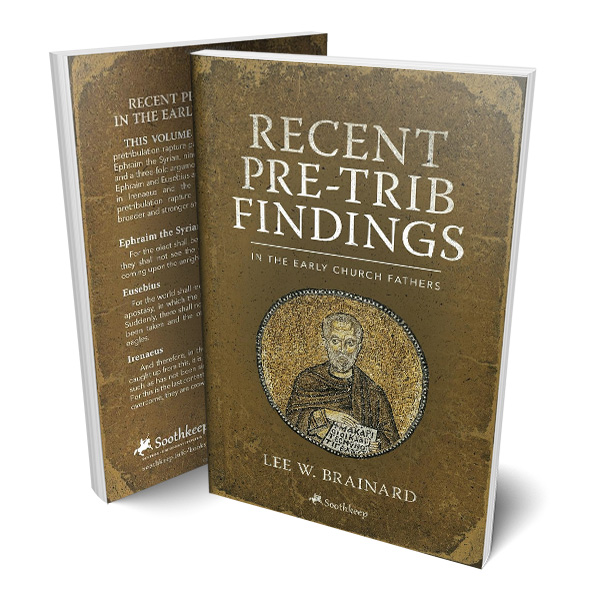
Lee Brainard: Well, let me just read a few out of this book here. We have Recent Pre-Trib Findings in the Early Church Fathers, and we…
Nathan Jones: You wrote that? That’s all your research?
Lee Brainard: Yeah, this is my research so that I have taken up stuff that was known about the Didache and Irenaeus and I went through those works and I strengthened the argument for the pre-Trib Rapture and then in my own research, I found nine pre-Trib Rapture passages in Eusebius and 10 in Ephraim the Syrian that were completely unknown to the evangelical world.
Nathan Jones: And so what time period are we talking about with these writings?
Lee Brainard: Well, Eusebius was in the third century.
Nathan Jones: Okay.
Lee Brainard: And Ephraim was in the late third century.
Nathan Jones: Well, that’s well before 1830 and John Nelson Darby.
Tim Moore: Exactly right.
Lee Brainard: Absolutely, so here is a very interesting passage in Irenaeus on a pre-Trib Rapture. “And therefore in the end, when the Church is suddenly caught up from this, it is said, there shall be tribulation such as has not been since the beginning, neither shall be. For this is the last contest of the righteous in which when they overcome, they are crowned with incorruption.”
So notice we have the phrase, “when the church is suddenly caught up from this,” and then it’s followed with the future tense, “there shall be tribulation.” So the tribulation follows the Rapture of the Church. This is just basic grammar.
Tim Moore: Yeah.
Nathan Jones: And the word caught up, where is he getting that from? What exact, because we’ll get again, people say, “rapture’s not found in the Bible.” But the word caught up is, and then, what’s the reference for that?
Lee Brainard: 1 Thessalonians chapter 4, verses 13 through 18, the classic rapture passage.
Nathan Jones: Okay. So they’re reading this right out of the Bible. They’re not inventing this in the 300s.
Tim Moore: And as a matter of fact, someone who speaks those or at least reads those ancient languages, you would tell us that the word rapture was a word, transliteration, if you will…
Lee Brainard: Yes.
Tim Moore: In the Latin version of the old Greek text. So the harpazo from Greek was translated into raptura or rapio. And that’s where we get the idea of rapture. The meaning of that word, whether in Greek or Latin, is simply caught up, snatched away as in the twinkling of an eye. So that word, that concept is right there in this particular passage.
Lee Brainard: And I like to tell people, even though it’s a common soundbite, the word rapture doesn’t appear in the Bible, I tell them that’s a mistaken soundbite because the Greek word harpazo is the exact same stem as Latin rapio, exact same stem is English rapture. The stem is R-A-P, and we could legitimately translate that, then we that are alive and remain shall be raptured up to meet the Lord in the clouds. And that would be a legitimate translation just as legitimate is transliterating angel out of Angelos and apostle out of Apostolos.
Nathan Jones: Interesting. Now, it’s just not in that passage, right? Doesn’t the Bible have examples of people being raptured to Heaven to show that this isn’t just a one and done verse, but this is a theme throughout the Bible?
Lee Brainard: Oh yeah. We have Enoch prior to the flood going up.
Nathan Jones: There’s also Elijah, right?
Lee Brainard: That’s right.
Nathan Jones: It looked like a chariot of fire. I’ve always wondered what that would look like. No, not a big Hemi engine or something like that, but, you know, going, taken up to Heaven. And we have people who, right, who were one of the themes of the Rapture is that the Lord removes His faithful before He pulls out His wrath or pours out His wrath on the world. So we’ve got Noah…
Tim Moore: And we even have John in the Book of Revelation in chapter four when the Lord says, “Come up here.” And John is immediately transported in the spirit into the Throne room of Heaven before he witnesses all the wrath being poured out. So over and over in Scripture, we have this type of a rapture, but the promise is for those who have put their faith in Christ.
Lee Brainard: Amen. And what a blessing it is. If you once start to understand the Scriptures that there’s a literal creation, there’s a literal time where the believers are wandering in the wilderness, spiritually speaking, and there’s a literal time of judgment coming and you understand that, you take it at face value, it’s a blessing to know we go up before judgment comes.
Tim Moore: Well, I know that one of the misguided criticisms that we often hear and we hear, even here at Lamb & Lion Ministries is that the pre-tribulation Rapture is mere escapism. But a skeptic could hurl that same charge about the Gospel. “Oh, you guys just don’t want to get the punishment of God.” Well, folks, that is the good news. The Good News is we deserve God’s punishment, but the punishment deserved by us fell upon Jesus Christ. Therefore, there is now no condemnation for us. So the Gospel is, in essence, escapism, and yet this idea is, we have said as old as the New Testament.
I found a book, This is the Glorious, or His Glorious Appearing. It was printed in the late 1800s. Folks, I think that you could have gotten this book delivered to your home for about a quarter in the 1800s, but at the tail-end, here’s what they have to say, the author, regarding what we’re talking about today:
“The impression prevails to some extent that he who teaches that Christ is soon coming is acting the role of an alarmist. If so, we have seen that the great Teacher,” capital T, Jesus Christ, “has placed Himself at the head of the class. No one has spoken more positively upon this point than He has done, but the message of Christ second coming is not sensational in its essential character. It is a solemn practical truth. It is full of warning and admonition to sinners and worldly professors and full of comfort to the faithful followers of Christ. It is spoken in the Scriptures as a fact, established upon the Word which never fails.”
And so yes, if we are called alarmists, well, then Jesus Christ is as well, but He warns those who are in sin to flee from the wrath to come, as we’ve said many times, and into His arms because only there is salvation.
Lee Brainard: And this accusation of being an alarmist is really, well, it’s a reflection of man’s unbelief. They don’t really believe that this world is destined for fiery judgment. Their ideas that this world’s going to continue going on more or less as it is for time unknown into the indefinite future.
Tim Moore: So why would a Christian who believes in Christ and is looking forward to their heavenly homegoing be contemptuous of the promise of the Rapture, especially at occurring prior to the Tribulation? Why has that lie been perpetrated so widely?
Lee Brainard: Well, it’s really because it’s part of the bigger piece of taking prophecy literally. They literally do not want the Jesus of the Bible descending from the heaven of the Bible to bring the judgment of the Bible upon the world at the end of the age. They’re comfortable with the world the way it is. They’re comfortable with the Church the way it is.
Nathan Jones: And that’s why they call us alarmists. What about those who are already Christians who call us escapists? Like, “We need to be here and represent the Lord. The Church needs to be here throughout the Tribulation. And so you just all want to escape.” Is there anything biblical to escapism?
Lee Brainard: Well, we’re escaping the wrath and that’s definitely true. But what these people don’t understand is that this isn’t going to be like a post-apocalyptic book that you can buy and read. This is the whole world being absolutely crushed by earthquake and fire. There’s nothing left except for the living human beings.
Nathan Jones: Yeah, we can read 1 Thessalonians 1:10 and 5:9, and of course, the greatest verse of all, Revelation 3:10, “Because you have kept my command to persevere, I will also keep you from the hour of trial,” the Tribulation, “which shall come upon” what? “The whole world to test those who dwell on the earth.” It’s a biblical concept that the Lord removes His faithful before He pours His wrath on the world. And yet I just see so many Christians are fighting against that. They believe that they too, “Well, if people suffered for Christ in the past, then why shouldn’t I suffer in the Tribulation?” They can’t seem to distinguish the big event, the big-t Tribulation from our little-t tribulations which we suffer through every day.
Lee Brainard: That’s right.
Tim Moore: Exactly right.
Lee Brainard: Oh, they don’t understand that we have suffered for nearly 2,000 years. Our time of suffering is coming near to an end and God has a plan to return to Israel to put her through her time of suffering to give her a second chance to receive the Messiah she rejected to receive the new covenant she rejected so she can receive her blessings and promises.
Tim Moore: You could argue that even unbelievers today who suffer, oftentimes the Lord is allowing them to come to the end of themselves, just as happened with the prophet Jonah. He went to the end of himself in the belly of the fish at the bottom of the sea before he relented, repented, and served the Lord faithfully, at least he went to Nineveh and preached the message he was told to preach.
Well, Lee, I also point out in 2 Peter, we go to this passage often in chapter 3 where He says, “In the end times, mockers will come with their mocking and saying, ‘Where is the promise of His coming?'” We’ve talked about how these are Christians in the Church. The world doesn’t even care about His promise, but it is a singular promise in this context that Jesus Christ will come. And they scoff because, “Well, He hadn’t come yet. Why should I get all excited?”
And then Peter reiterates, “The Lord is not slow about His promise,” promise of what, to come again for those who are His, “as some count slowness, but He’s patient toward you, not wishing for any to perish.” I find that the scoffing is not just directed at the promise itself. What must be most calling to God is, anyone who’s scoffing is scoffing really and truly at the promise keeper Himself.
Lee Brainard: That’s right.
Tim Moore: If you scoff at His promises then you’re scoffing at God as being a promise keeper.
Lee Brainard: Well, it reminds me of the problem people have. Well, we shouldn’t be serving God for reward. We should be serving Him for His glory alone. But if God is promised reward and encourages to serve for reward, you are actually undermining the character and glory of God.
Tim Moore: Wow.
Nathan Jones: That’s an excellent point. And then we get to Titus 2:13, which calls the Rapture, the return of the Lord, our Blessed Hope. We had Ron Rhodes, Dr. Ron Rhodes is a wonderful speaker, at one of our conferences and He did what you did, he laid out all the horrors of the Tribulation and death and destruction. And so if the Rapture occurred at the Second Coming, would that be our Blessed Hope? Would the angels go out and gather whatever people are left in the world and they fill just one valley? How would there be any hope because most people would die?
Lee Brainard: Yep.
Nathan Jones: Well, Lee, I get this argument all the time, Tim does too, that people say, “Well, you know, I grew up in the Jesus movement of the ’70s and ’80s. I grew up through the big Left Behind movies and books in the 2000s, in the ’90s and 2000s, and yet Jesus hasn’t come. People of greats, like Tim Lahaye have passed away and they should have gotten the Rapture in their lifetime, so why should I even consider that the Rapture will be happening in my lifetime?”
Lee Brainard: Well, every generation from the apostles to the present day has lived under the expectation of the soon coming of the Lord, lived under the expectation that the Lord could come in their generation. And this wasn’t without reason. I mean, think about it. If you lived in the first generation of the Church, you had just seen the events of the 69th week come to an end, you saw the Messiah close, you know you’re in Daniel chapter 9:24-27 and you know the destruction of Jerusalem’s coming and you can assume reasonably that this is prophetic convergence coming together and you’re going to see the Second Coming of the Lord because you know the Lord’s going to come and deliver Israel.
As time goes on, every generation has seen prophetic convergence increase. They lived under the assumption things would accelerate to the Second Coming. The Lords wanted us here. Now, as Dr. Walvoord says, “As we get closer to the end, the people are going to have, they’re going to see more of the convergence developing in the world and they’re going to have a clearer understanding of prophetic scriptures, and we’re going to realize that we were closer than we were before.
Tim Moore: So we have the blessing, as you might say, of hindsight…
Lee Brainard: That’s right.
Tim Moore: that we understand more clearly, even than some of the early Church Fathers, even than the Medieval folks, the people in the last century. We’ve seen, for instance, the regathering of the Jewish people, the house of Israel to its land. So we of all people should consider ourselves blessed to have seen what we have seen, but, Lee, what would you say to someone who scoffs regarding the benefit that a Christian who has already gone home to be with the Lord, receives for having anticipated His Rapture even if it didn’t occur within their lifetime? Is that a… Is there no point to their anticipation or is there a blessing that they would’ve received even though He tarried?
Lee Brainard: Well, I think that there’s a blessing for every aspect of the Bible testimony that we embrace. The more of the Bible that you embrace, not just merely in a theoretical way or just in the mere letter of Scripture, but you embrace it as a reality in your life. For every one of these things, there’s reward, and simply looking for and longing for the coming of the Lord is really one of the greatest barometers in the Bible on the state of your heart.
Tim Moore: Oh, well, I would argue as well that as you read some of these books, again, from 130 years ago, these people were highly motivated to serve the Lord practically through evangelism, through sharing the Gospel all around the world because they anticipated Jesus to be coming soon. And of course we’re told by Paul himself that “all those who have longed for the Lord’s appearing will receive a crown of righteousness.”
Brothers, I’ll tell you what, even if the Lord tarries beyond my lifetime, I want that crown. I may not get any others, but I am longing for His appearing, so Paul says that like himself, I will receive a crown of righteousness.
Well, we’re talking about this reflection of the pre-Tribulation Rapture and how the Church has sometimes been straying from belief in this. We’ve just recently celebrated America’s 250th Anniversary, it’s semi-quincentennial, and some of the founding principles that this nation was founded upon, the self-evident truths and other things, let’s just say we have drifted or perhaps fallen far from our Judeo-Christian roots. So applied to the Church, how have we drifted into confusion or even just blase carelessness about some of these promises, especially over the past 2,000 years?
Lee Brainard: Well, the Bible message of redemption, which we call the Good News, revolves around two poles. The south pole, or the first pole, is the first coming where the Lord Jesus Christ paid for redemption. The north pole, the second pole, is the Lord Jesus’ second coming to bring the redemption that He paid for. Now, when you have Christianity going forwards and they’re saying, “Well, we’re just, we don’t think the second coming is that important. We’re just going to set it aside or it’s divisive.” This is like a globe on one pole, it’s going to wobble. It’s an unbalanced message. It’s not the whole message of redemption.
Can you imagine someone going into an auto dealership dropping $250,000 on a brand new sports car and then walk out, leave the keys in the counter, never take possession of that? You would think they were a few bricks short of a full load. Well, it’s the same way. Why would we want Jesus paying for redemption and we wouldn’t…and paid for it for us, and then we’re not going to take possession of redemption? When the Church goes forth not excited about the Second Coming, this is really a sad testimony about their spiritual state. They don’t want Jesus to come down and mess their world up.
Tim Moore: Oh, boy.
Nathan Jones: I got a pastor friend of mine who does believe in the Rapture, but he says, “Well, it has no bearing on my life. And so I don’t bother teaching it in the Church. It’s too divisive. There’s other things.” But then the Church seems constantly bogged down with all the little details in life. They take the picture off of God and they put it down onto their own lives and it becomes its own little world. The beauty of the teaching of the Rapture of the Church, the return of Jesus to set up His kingdom and rule and reign over this earth is it gives you that 30,000-foot view that makes the problems in this life seem so minor compared to what we have.
So what advice do you have for these pastors who, growingly were seeing it, are getting scared actually to talk about the Rapture from the pulpit.
Lee Brainard: Absolutely. And I think one of the things that they need to bear in mind is the Scripture is very clear. He that has this hope in himself purifies himself as he is pure. There’s a sanctifying aspect about the pre-Trib Rapture…
Tim Moore: Amen.
Lee Brainard: that gets people excited about the things of the Lord. If you’re living in the expectancy that at any moment you could be giving account to the Lord and receiving your reward, this weans you away from the world. But there’s a deeper element. If you really enter into the fact that we’ve got an infinite eternal reward coming from an infinite and eternal God in an infinite universe that’s an infinite utopia with infinite time, infinite energy, infinite resources, and infinite opportunity, how in the world could you get too excited about the handful of sand that this world is when you got a handful of diamonds coming?
Tim Moore: Exactly right.
Nathan Jones: Wow.
Tim Moore: Well, I’m excited about the fact that just a few decades ago, I think there was kind of a resurgence of anticipation. You had books by people like Tim LaHaye, obviously Hal Lindsey and others, Dr. David Reagan, who started this ministry in 1980. There was almost a buzz of anticipation. And yet here we are a few decades later and some of that buzz, well, within our circles it’s still buzzing very strong, we are very excited, but the Church as a whole just seems to be yawning instead of yearning. And so our encouragement is that you would yearn…
Lee Brainard: Amen.
Tim Moore: and not yawn because we are getting closer day by day. The signs of the times are not just multiplying and increasing in frequency and intensity, they are converging like never before.
Lee Brainard: Absolutely. And we live in a very exciting time. To me, when we look around and we see the Church moving in the direction of lethargy and lukewarmness and we see people drifting away from dispensationalism, I think what we need to see is glorious opportunity. For the remnant Church, this can be the Church’s finest hour. We can get on higher ground than we’ve ever been for in our doctrine, understanding, or discernment. If we don’t, this is problematic. We have shoulders to stand on. And we have the same glorious promises that the Lord has held out to the entire Church, we can apply them in the remnant Church, and there’s no reason why we can’t see…
Tim Moore: Amen.
Lee Brainard: some of these people be drawn back in to excitement about Jesus Christ.
Tim Moore: Well, obviously we are excited. So in the time we have left, let’s go through a lightning round of why we believe that the Rapture is imminent and will take place before the Tribulation. So what would you say is one of the lead reasons that we think the Rapture could happen at any moment?
Lee Brainard: Well, I love the whole concept, “no man knows the day or the hour” found several places in the Gospels including Matthew 24. I love this because you can know the day or the hour of the Lord’s coming if you once enter into the Tribulation. You can mark it, count it from the beginning, count it from the middle. There’s no mistaking it. The nations of the world gather at the right time and place, the armies of the world for Armageddon.
Tim Moore: So you can know when the Second Coming is going to occur…
Lee Brainard: Absolutely.
Tim Moore: but not the Rapture. That’s the idea of eminence.
Lee Brainard: That’s right. The world’s going to be caught by surprise. The thief is going to come in the night. He’s going to rob the world of the Church and they’re not going to know that there’s a problem happen until they realize tens of millions of people are missing.
Nathan Jones: I love that because that’s what Jesus said, that He’s coming as a thief, unexpected as a surprise.
Lee Brainard: That’s right.
Nathan Jones: You know, the thief doesn’t announce he’s coming. That would be the Book of Revelation the Second Coming. The thief has to come unexpectedly, that’s the Rapture.
Lee Brainard: That’s right.
Tim Moore: Nathan, any other ideas on a lightning round of why you expect the Rapture to occur imminently or before the Tribulation?
Nathan Jones: Well, if the Second Coming and the Rapture both happen at the same time at the end of the Tribulation and we get our glorified bodies, we come back to the earth, make a U-turn and set up the Christ’s Millennial Kingdom, how would children be born in that kingdom if those glorified bodies Jesus said are like the angels that don’t reproduce? It has to happen before so you have people in their earthly bodies who are the citizens of the kingdom.
Lee Brainard: Amen.
Tim Moore: Amen. I would add to that, that the entire tribulation period as described by John is “the outpouring of God’s wrath.” We’ve just had an extensive teaching series on a Prophecy Chart or an Overview of the End-Times and if we trust and believe that there is now not just a little bit or a lot, there is no condemnation for those who put their trust in Christ, we are not subject to the wrath of God that will be poured out on the unrepentant world, and let alone the fact that the Rapture is a promise given to the Church, not to Israel, we talked about Israel and the promises held up for it last week, but to the Church.
And finally, I believe that the Rapture is a promise given to Jesus Christ that He will come for His bride.
Lee Brainard: Amen.
Tim Moore: And He doesn’t need her to be beat up or purged. He’s already done that on our behalf and He wants us to come to Himself as soon as the Father says go and get your bride.
Well, that leaves the three of us and all of those of you who are watching and waiting, anticipating the Lord’s in return. So Lee, you have a couple of books that you’ve already showed us about. The Recent Pre-Trib Findings, and what else?
Lee Brainard: This is Ten Potent Proofs for a Pre-Trib Rapture.
Tim Moore: Recent Pre-Trib Findings.
Nathan Jones: And we got this one by Dr. David Reagan.
Tim Moore: The Rapture: Fact or Fiction. So folks, if you want to know why you too should believe that the Lord is coming soon and be excited about that glorious Good News, if you’re already a follower of Christ or flee from the wrath to come by putting your faith in Him, we’d encourage you to call the number on the screen or go to our online store and we would be glad to send you these three resources that will be a tremendous encouragement to you.
Closing
Tim Moore: Well, folks the three of us are excited about the Lord’s soon return. I would dare say we take God at His Word and so we would encourage all that are watching not to scoff about the promise of His coming.
Nathan Jones: So real quickly, Lee, how does one become a member of the Church and so participate in the Rapture?
Lee Brainard: I am glad you asked that. This is the most important question and it’s a very simple answer. All you have to do is believe on the Lord Jesus Christ and you shall be saved. It’s not religion, it’s not baptism, believe on Jesus.
Tim Moore: Believe on Jesus unto salvation. Obviously, Satan knows that Jesus Christ is Lord and Savior, but when you put your trust in Him for your salvation, you will be saved. Well, the Lord said, “Behold, I am coming quickly.” We believe that will happen before the Rapture. The question is, do you?
Well, all right, between last week and this week, folks, we discussed Christian Zionism and the fact that it is as old as the New Testament and then the 2000 years that faithful Christians have been longing for the return of Jesus Christ. We talked about that today, but there’s still much more that could be said. So Lee, again, if you’re willing, we’re going to continue this conversation. You mentioned standing on the shoulders of the faithful. Let’s pick up on that theme next week.
Lee Brainard: I’m looking forward to that conversation, brother, because it’s going to be the frosting on the cake.
Tim Moore: Amen.
Nathan Jones: And folks, how could they get in touch with your ministry and watch your great videos?
Lee Brainard: They can watch my videos on Soothkeep YouTube channel. They can check out my website, soothkeep.info, and they can find me on many social media venues as Soothkeep.
Tim Moore: Amen. Well, before we close out today, we pray that you are longing for Jesus’ soon return. And if you are, Paul says that you will receive a crown of righteousness, which the righteous judge will award to all those who have loved His appearance.
And Jesus may come before we end this show or He may come this week, or He may tarry as the father demonstrates patience wishing that none would perish, but He is coming. And we pray that when He does, you will hear His upward call. If so, we’ll look forward to seeing you in the air! Godspeed!
End of Program
