

Is the book of Revelation all about doom and gloom, or is it about hope? Find out with Tim Moore and Nathan Jones on the television program, Christ in Prophecy!
Air Date: January 10, 2026
Resources
To order, call 1-972-736-3567, or select the resource below to order online.
Transcript
Tim Moore: Greetings in the name of Jesus, our Blessed Hope!
Throughout our Inquiring Minds Series, we have presented mysteries throughout God’s Prophetic Word, because we take God at His Word, we interpret Scripture using the “plain sense” principle Dr. David Reagan emphasized, “If the plain sense makes sense, look for no other sense, lest you end up with nonsense.”
And we believe that Jesus is the key to understanding the deep mysteries of God. In Him, the prophetic promises are fulfilled, He is the ultimate “Yes and Amen.”
Nathan Jones: For the past few Inquiring Minds Series episodes, we’ve been in the Book of Revelation. The visions John recorded, shared with him by Jesus, are far-reaching and fantastic. Not fantastic in the sense of incredible or unbelievable, but at the extremes of our ability to understand.
And even as I say that, we absolutely believe that God intends for us to understand what He has chosen to reveal. Sometimes that understanding comes over time, or as the End Times unfold. At other times, understanding comes through careful study and always understanding comes through the illumination of the Holy Spirit.
Tim Moore: Nathan is right. We take literally the promise of Deuteronomy 29:29: “The secret things belong to the Lord our God, but the things revealed belong to us and to our sons forever. Moses went on to explain that God has revealed what we need to know in order to “observe all the words of this law.”
With that in mind, we want to pause in our analysis of some of the horrors that will befall the Earth during the Tribulation to consider “The Joy-Filled Hope of Revelation.”
Part 2
Tim Moore: Well, Nathan, the question is; amidst all the doom and gloom of Revelation, all the horrors that fall through the Seal, the Trumpet, and Bowl Judgments, is there hope in Revelation?
Nathan Jones: Yeah, it’s a shame that people approach the Book of Revelation, or I should say unapproach the Book of Revelation, because they think it’s filled with doom and gloom, there’s locust monsters and death tolls, too astronomical to count, there’s a destruction of the world, there’s suffering, there’s martyrs, and people are like, “Oh, man,” pastors especially might not even want to get in–I mean, nothing’s more depressing than going to church on Sunday and hearing about the death toll of a quarter of the world population.
But the Lord inserts inside Book of Revelation chapters, flash forwards to His victory. We see pictures of the Throne Room of God, we see Jesus triumphant, and they break up the narrative to give us hope, otherwise, Tim, I think we would just put the book down after Chapter 4 and say, “That’s it.”
Tim Moore: “That’s it,” yeah. When we get through the letters to the churches, we think, “Well, some of these chapters don’t even apply to us, if we’re not going to be on the Earth, because the Rapture has occurred, so why would I need to study it?” And we have to realize that Jesus communicated His Revelation to us for a reason.
And, yes, it was written primarily to the churches, which is to say by extension, all of us who have put trust in Christ, so we’re going to try to understand what that reason is. But we know that Jesus, as I said earlier, is our Blessed Hope. Folks, that comes straight from the Book of Titus, where Paul wrote that we should be “looking for the blessed hope and the appearing of the glory of our great God and Savior Christ Jesus.”
So it’s both an event that we anticipate, the Rapture, and the person of Christ. We refer to Him as our Blessed Hope because it’s only through Him that we have the assurance, the blessed assurance, that we will go with Him at the Rapture.
Nathan Jones: Similarly, you can go to Matthew 24 and Luke 21, which is Jesus’ big sermon on the End Times and the signs of the End Times. And how does He end it? The final sign is the sign in the sky that proclaims the day of Christ, that day of Christ being that last day of the Tribulation when Jesus returns in all His glory. So I love the fact that all of Revelation points to our number one hope is Jesus Christ and His return.
Tim Moore: Amen.
Nathan Jones: Again and again, it’s not Jesus the baby at Christmas time, it’s not Jesus on the cross that most Christians leave on the cross. Some Christians allow Him to get out of the grave, but never to return in all His glory and majesty, defeat evil and set up His kingdom. That’s really what Revelation’s about.
Tim Moore: It is Jesus presented triumphant, Jesus presented glorified, Jesus depicted even vindicated in human history…
Nathan Jones: Good point.
Tim Moore: Not just in the spiritual realm, but in history…
Nathan Jones: Good point.
Tim Moore: Finally exerting His authority, His righteousness, even His judgment over all the Earth. I love the way the old negro spiritual puts it so beautifully, I love these songs:
In the morning when I rise, give me Jesus.
Dark midnight was my cry, give me Jesus.
Just about the break of day, give me Jesus.
Oh, when I come to die, give me Jesus.
And when I want to sing,
Nathan, I feel like singing right now,
Give me Jesus.
And the frame itself which says,
Give me Jesus, give me Jesus.
You may have all the rest but give me Jesus.
And really that is the hope of those who have put their trust in Jesus Christ, and it is a blessed assurance that none of these horrors of Revelation await us.
Nathan Jones: You know, I frequently get questions, and I’m sure you do too, from Christians who have lost loved ones, especially spouses, and they feel that their spouse or loved one is sitting up in Heaven, incomplete, lonely. I even heard one person who lost their wife and been praying the Lord to give them a puppy, so that they have some fellowship.
But you bring up a great point in that spiritual is the very fact that Jesus is the all and all we’ll need. That’s why at the Marriage Supper of the Lamb, there’s that spiritual union which we can’t understand at all, but Jesus becomes our all in all, in our glorified bodies, we might need to eat from the Tree of Life, you know, we might need to live…
Tim Moore: Yes.
Nathan Jones: As we would live every day, but in the end, Jesus fills everything. And so, He’s our all purpose, and we walk around this Earth incomplete and broken, and we’re not going to be whole again until we have that spiritual relationship with Christ.
Tim Moore: That’s a beautiful metaphor you used, because even the picture of the wedding feast for Christ and His bride, those of us who are His within the Church, it points back I think to the reference in the Old Testament, at least in the old English translations of our Bible, where it talks about the patriarchs, whether it’s Abraham, Isaac, Jacob, they knew their wife. In other words, when they came together and unified and became one flesh, this knowledge, this intimacy, and without being sexual, the point is that when we are known as we will be known, and when we know Christ, when we are unified with Him, boy, Nathan, it just is mind blowing to think that our great God and Savior would call us into that intimate relationship.
So, our first hope is none other than Jesus Christ, and that is a blessed hope that we can have and seize right now through putting our trust in Him.
But that brings us to our second hope, and that is the encouragement Jesus offers by intentionally communicating with us. He didn’t have to give us this Revelation shared with Him by the Father, but He chose to communicate it to us.
Nathan Jones: And He did it so that we’d have hope. So not only is our Great Hope, Jesus Christ, but our great hope, too, is that we have a personal God. I mean, look at the Muslims for instance, their End Time belief system, their Heaven system, Paradise, is a distant, unknowable Allah who has nothing to do with them for all eternity.
The Lord has made all of human history about a redemption arc to bring a remnant to live with Him forever in Heaven, in perfect fellowship; it’s the Garden of Eden relationship where Adam and Eve, that Jesus was their best friend, they walked and talked and they had fellowship, they saw the Father face to face. And we’re not going to see the Father face to face until we get to that eternal state. Because the Father, once we are pure and holy by the Blood of Christ, we can now stand before the Father back in that perfect…
Tim Moore: Amen.
Nathan Jones: Relationship again. A personal relationship, a personal God.
Tim Moore: So we know that already in the first advent, Jesus condescended to come down to live as one of us, to live among us, to become that vehicle of salvation through His death, burial, and resurrection. And we also know that before God’s wrath is poured out on the Earth, as is described in Revelation, that Christians are assured that He knows how to rescue us from the wrath to come.
And we pray that unbelievers who perhaps are watching this program are hearing from those of you who are watching that they can turn from the wrath that is to come that abides on all who have rejected Christ, and be welcomed into the family, the very kingdom of God right now. And then even, Nathan, if those who perhaps are watching this during the Tribulation, will recognize that they should soften, not harden their hearts, to accept the salvation that God continues to offer, even during that time of tribulation.
But this brings us to that third hope. We talk so much, and you and I have focused already on the Seal Judgments, we’re going to talk about the Trumpet and the Bowl Judgments in weeks to come, months to come, again and again we’ll return to this book. And yet interspersed throughout all those judgments, all that wrath are scenes of tremendous encouragement and hope, even for those of us who have put our trust in Christ.
Nathan Jones: Oh, yeah, I mean even the Book of Revelation that starts off in Chapter 1. And so, in Chapter 1 we got poor John, old, all his fellow apostles are dead, banished the Isle of Patmos, he’s not with his church in Ephesus. And all of a sudden, the Lord Jesus Christ breaks out of the sky.
And it’s so… I mean, John falls to his feet because Jesus is not coming just His resurrected body, but in also His glory. And it’s astounding and amazing and all. And so, the Bible starts out right from the very beginning of giving us hope, that hope is the flash forwards that we have to Jesus’ victory.
I think, Tim, and I’m guilty of it myself many times, is that we make a very small Jesus that our human minds can wrap around, and He seems to perpetually be losing a battle to Satan. And it seems like He’s never going to win, and we’re going to always suffer, and as Christians, you know, we get down. And in those moments, we turn to something like the Book of Revelation, Chapter 1, where all of a sudden, you see God in all His glory and you’re like, “How can I think that evil could ever triumph over God unless He allows it?
Because He’s all powerful.” When we get to the end, and I’ve got to skip to the end here, when He returns to this Earth, He speaks and His enemies melt before Him, that’s the kind of God that we have. So absolutely the flash forwards to Christ’s victory that we see in Revelation is our third hope.
Tim Moore: It puts us in perspective of what really matters. Can you imagine John, you made the point that he was sort of the last man standing among the apostles, he’d been exiled, he may have felt down and out, we don’t know the state of his mind, but after seeing the Glorified Christ, after seeing all the other visions of what awaits, when John returned to this Earth and continued his life until his death, can you imagine that he ever had the same “woe is me” perspective again?
He had seen what awaits, I mean he had to be kind of walking on air, and I think that’s what we can have in terms of an internal perspective. So, yes, Chapter 1 is instructive as to giving us the vision that Jesus chose to share with us. And, of course, in Chapter 2 and 3, we’ve talked extensively about the churches of Revelation. But in terms of the hope, over and over again, Jesus makes promises to those who overcome.
And we know in the definition given in 1 John 5:5, “The one who believes that Jesus is the Son of God is by definition an overcomer.” So those of us who are followers of Christ are given promise after promise after promise that we can look forward to.
Nathan Jones: Yeah, and what’s interesting about those seven letters to the seven churches is even though there were period churches of Asia Minor, now Turkey, they represent eras of the Church Age and they represent churches today. So we always think Revelation is future, but Chapters 2 and 3 are present.
Tim Moore: Yes.
Nathan Jones: They’re about the Church Age now. And the fact that the Lord, you know, if He didn’t care about us, He wouldn’t be giving these messages, but He says, “No. Hey, you know, you’re weak, you lost your first love, or you’re falling into idolatry, or you’re falling into apathy, overcome that. Listen to Me, I will reward you, I will give you this glory being in My presence and sharing in all my kingship, if you would just give up these sinful or fallen nations.”
So it’s beautiful to see that Chapter 2 and 3, at times can sound a little like condemnation, but for the most part, it’s, hey, a parent disciplines their child because they want them to turn out right.
Tim Moore: That’s right. It is. It’s a form of discipline, and Lord admonishing not to tear down or to beat down, but really to call back. That’s the very word “repent,” we’ve talked about that many times. Repent is not a one-time thing that Christians do to repent of their sins, it’s an ongoing, if necessary, turning back.
Those of us who are sheep, as Jesus describes, know, some of us, that we are “Prone to wonder, Lord, I feel it. Prone to leave the Lord I love.” If we wonder away, Jesus, the Good Shepherd, comes after us and calls us to turn back, to repent, and get back on the straight and narrow. That’s what’s in Revelation 2 and 3, and even that is glorious hope for those of us who want to stay dedicated to Jesus Christ.
But that brings us now to the next scene, the next interlude, which is Chapter 7, and that is an interlude between the unveiling of some of the Seal Judgments. And, Nathan, I’ll just observe that it was Habakkuk who hearing about great wrath about to be poured out, or judgment, upon the nation of Israel said, “Well, Lord, in wrath, remember mercy.”
And Chapter 7 and others that we’re going to talk about prove that even as wrath is being described, God remembers mercy and He has provision for people to be given the Gospel and to have the opportunity to come to salvation during the Tribulation.
Nathan Jones: Yeah, even though He’s removed the Church from this Earth, obviously, salvation is still in the Tribulation, which means the Holy Spirit’s still there.
Tim Moore: Yes.
Nathan Jones: Even people say, “Well, how does anyone get saved without the Church there?” Well, the Holy Spirit doesn’t need that. He initially starts with 144,000 Jewish evangelists, He sends them out, and we read in Verse 9, “After these things I looked, and behold, a great multitude which no one could number of all the nations, tribes, peoples, and tongues, stood before the throne and before the Lamb, clothed in white robes with palm branches in their hands.”
These are the people that get saved after the Rapture, but during the Tribulation, as a result of the messages of the 144,000, as the wrath of God makes them bend a knee, we’ll talk about the two witnesses, all these different things. So even though the world will see its worst time ever, salvation will spread. You know, Tim, this verse might indicate that more people get saved in the Tribulation than the entire 2,000 years of church history.
Tim Moore: I pray that is true. And the sad thing is some of you may think, “Well, I’ll just wait till the Tribulation…
Nathan Jones: No…
Tim Moore: “And then I’ll put my trust in Christ.”
Nathan Jones: No.
Tim Moore: What’s the danger of that is we’re not guaranteed that you or any of us will live to the Rapture and enter into, well, if you haven’t put your trust in Christ, the Tribulation, you may be called to meet your Maker today, tomorrow, this week, none of us knows. And so, it’s a fool’s bet to say I’ll just wait and see.
Nathan Jones: Yeah, yeah, obviously. Well, we skipped up to Chapter 11, which is the next fast-forward or interlude here. And, again, God is giving us another witness to the world, and that’s two witnesses, two men, some believe they might just be men who were designated that time period, others think they’re prophetic like Enoch and Elijah or Moses and Elijah.
And they will go into Jerusalem, and for three and a half years, the first half of the Tribulation, they will witness to the world, they will do supernatural, they’ll be like the Old Testament prophets, and the Antichrist will–God allows him to kill them, they sit in the streets in their dead bodies for three and a half days. The whole world celebrates just as so many did when say, Charlie Kirk was assassinated…
Tim Moore: Ooh.
Nathan Jones: Disgusting. But they will be resurrected and the whole world will see it. And so, at least for the first half of the Tribulation, the Message of God will go out through these two witnesses pointing to the fact that God hasn’t given up on humanity.
Tim Moore: You know, it also points to the fact that these two witnesses will be perceived by much of the world, and it describes as the “whole world celebrating.” Well, folks, we’re literalists and yet we know that there are Tribulation Saints. They won’t be celebrating the death of these witnesses, because they will have put trust in Christ.
But, relatively speaking, the entire majority of the world who has rejected Christ, who is still shaking their fist at Him, will celebrate the death of these witnesses. In the eyes of those people, in the eyes of the Antichrist, these witnesses of God would be what we call troublers. And it’s interesting to me that Elijah was the original troubler…
Nathan Jones: Of Israel, yeah.
Tim Moore: Who as he approached the Mount Carmel contest with the prophets of Baal, Ahab who had given himself over to wickedness through the influence of his queen, Jezebel, said, “Oh is it you, you troubler of Israel.”
And so many in our society today, you mentioned the outrageous response by many, especially on the left, to the death of Charlie Kirk, they have given them themselves over to wickedness, into ungodliness, even to the point of celebrating murder. Homicidal maniac killing a person, assassinating a person, and they rejoice? I can’t fathom that, but it is that kind of heart that will perceive these two witnesses the same way Ahab saw Elijah as a troubler.
You mentioned earlier that the Holy Spirit will be in the Earth, clearly, but Scripture talks about the restraining force. We believe that is the presence of the Church that is restraining certain evil, but you can only imagine the laws and the policies that will be enacted when the Church is not here, and the Antichrist begins to rage throughout the Earth.
And yet, in the midst of all that, between the 144,000, these two witnesses, God is going to ordain that the Word of the Gospel still goes out. And Nathan, you’ve talked about this evangelizing angel that circumnavigates the globe, ensuring that every person knows about the Gospel.
Nathan Jones: Oh yeah, yeah. But first, we’ve got to do Chapter 12.
Tim Moore: Okay, we’re going to get to Chapter 12.
Nathan Jones: Because we got the great sign of Chapter 12 where–okay, we’ve been talking about the nations, let’s talk about the Jewish people. Has God given up on the Jewish people? No, the Tribulation is primarily, especially the second half about getting a remnant of the Jewish people, a third of the Jews to come to Jesus as Savior. It has this beautiful story, it gives the story of Jesus being born of Israel, and then the Jewish remnant being protected in the wilderness.
Tim Moore: Yes.
Nathan Jones: And we believe that the Jewish people, a remnant, not all of them because the Antichrist attacks Jerusalem, so there’s got to be some Jews there.
Tim Moore: Kill two-thirds.
Nathan Jones: But a remnant of them will be kept in the wilderness, supernaturally protected, and they are the ones who along with the Gentiles survivors, will live on into Christ’s Millennial Kingdom. So, the Lord wants to give the Jewish people during that time hope, “Hey, I’m going to be your rescuer.”
Tim Moore: Right.
Nathan Jones: He’s going to come back and rescue them again at the end, but at this point in the middle of the Tribulation, a remnant is protected, some believe in Bozrah are aware that third “Indiana Jones” movie took place…
Tim Moore: Petra?
Nathan Jones: Petra, yes, uh-huh.
Tim Moore: Yeah? Well, I think this is also instructive to us and is an application point, even though there is great hope given to the Jewish people that this remnant will be protected, Nathan, it is a minority remnant. So as our friend Olivier Melnick says, “It’s heartbreaking to realize that two-thirds of the Jewish people will be killed by the Antichrist prior to this point.”
One-third will be preserved and saved through this period of time, but the majority will not. And that’s the same for the rest of the world, the majority will be killed either by the Antichrist through the various wars. We know that at first, a quarter of the world’s population, and following that, a third of the world’s population will be killed, and then it gets even worse. So half the world will be slaughtered.
Folks, this is nothing anyone wants to play around with or live through if they can avoid this period of time, which is why the most important hope we can emphasize is the hope of salvation, which is a promise that you don’t have to endure all of the calamity of Revelation.
Nathan Jones: But salvation isn’t done yet.
Tim Moore: No.
Nathan Jones: Because then we get to Revelation Chapter 14…
Tim Moore: Yes.
Nathan Jones: If we read Verse 6, the Lord sends out three angels, this is the first one, “another angel flying in the midst of heaven, having the everlasting Gospel to preach to those who dwell on the Earth to every tribe, tongue and nation.” And what does he say? “Fear God and give glory to Him for the hour of His judgment has come, and worship Him who made heaven and Earth the sea and springs of water.”
So the Lord then sends an angel out, and he finishes the Great Commission. He goes to every single person alive in the Tribulation and gives them the Gospel, so that by the end of the Tribulation, there is nobody who’s without excuse.
Tim Moore: Absolutely. We’ve talked about how we are approaching the time when we think, virtually, every nation, tribe, and tongue has been reached by the Gospel. Even through modern technology you can speak into your phone, and it’ll be translated into languages from around the world. But the Lord is so determined that no one misses the message that He will send this angel even to those during the Tribulation who have rejected Him during this, as we know, the Church Age.
Well, in Chapter 15, based on all these things John has seen, he records yet another outburst of praise as those who overcame the beast sing what is called the Song of Moses. And this ties back to Moses who delivered his people out of bondage, and these people sing a song that they credit to being his written for those who have been delivered from the bondage of sin, the bondage of death, and now rejoice around the throne of God.
They also sing the Great Song of the Lamb. I don’t know the tune to these songs, But the words themselves are beautifully written.
Nathan Jones: We will one day.
Tim Moore: We certainly will, because we’ll join with them.
Nathan Jones: That’s amazing, yeah. “Great and marvelous are your works Lord God Almighty. Just and true are your ways, O King of the saints. Who shall not fear you, O Lord, and glorify your name? For you alone are holy. For all nations shall come and worship before You for Your judgements have been manifested.”
Now that’s the English translation, I’m not sure if we’ll all be speaking our own different languages, and there’ll be like a universal translator. I’m sure hoping it’s not all Hebrew, but it’s a beautiful song that we’ll be singing before the Lord. The love that the Lord has will just gush on us, and we will, in turn return that love, it’ll be a beautiful, beautiful thing.
And as the world is praising the Lord, the Church up in Heaven is preparing to come back with Jesus Christ, and so, we skip up to Chapter 19, and this is the time for the Lord to come. There’s a hallelujah for the Lord our God Almighty reigns, the Lord breaks through the clouds on His great white war charger, the Saints, that’s us, folks, if you’re saved, will be on horses, I’m not sure Pegasus, or…
Tim Moore: Who knows?
Nathan Jones: Or angels or what, but we will follow Jesus. And this is a beautiful, beautiful scene, and Jesus in all His glory riding that White Horse, He has on His robe and on His thigh, the name “King of kings and Lord of lords.” If there is a climax to the Bible, I think Chapter 19 is that.
Tim Moore: I think it is, too. And yet there’s more to come, because we know that after the Lord defeats the enemies arrayed on the Earth, the Antichrist and all his armies, that He imprisoned Satan for a thousand years, a Millennial Reign, and following that thousand years when He absolutely casts Satan into the Lake of Fire, then we know that the New Heavens and the New Earth are brought down, and that we live with Jesus forever where a river flows from this very throne, the Tree of Life is there, and we have life everlasting. This is such hope.
So, too many Christians look at Revelation and complain, “It’s hard to understand, it’s scary.” But for those who have put faith in Christ, there’s nothing but affirmation of the hope that is ours, the Blessed Hope, that Jesus is coming for us.
Nathan Jones: Yeah, because once the Tribulation is over, it ends with Jesus Christ just speaking and the armies of the Antichrist melt before Him. I mean we worry about the world’s systems of today oppressing us, and all Jesus has to do is speak and the armies of Armageddon just collapse. He gets Satan and He throws him in a pit, I believe the demons to the Lake of Fire, because you don’t see them in a Millennial Kingdom.
Tim Moore: No.
Nathan Jones: And you’ve got the Antichrist and false prophet, the first residents of Hell. The world is celebrating, Babylon the Great has fallen, right? Jesus then sets up His Kingdom a thousand years prelude to the eternal state of peace and righteousness and justice, that perfect society that we’ve wanted, and then on into the eternal state.
And He even, before the eternal state, resurrects from the dead, from Hades, those in rebellion, in the Great White Throne Judgment, He judges them, and since they’re missing the work of Jesus Christ to save them from their sins, they’re cast in the Lake of Fire, and then He throws Hades and death into the Lake of Fire, so that He has defeated all His enemies.
You know,, it boggles my mind when pastors say, “I don’t want to teach Revelation, it’s too scary, you know, it’s too divisive.” It’s about Jesus’ victory…
Tim Moore: It certainly is.
Nathan Jones: Why would we not want to speak about Jesus’ victory?
Tim Moore: Well, obviously, God does not want us to be dismayed, discouraged, or confused, or frustrated, so He chose to reveal what is to come in order to give us assurance and to foretell what lies ahead.
And the question is why? Why would He do that? It’s so that we do not, again, grow discouraged even as darkness descends on the Earth, as some rage and celebrate murderous hate. It’s also so that we will recognize that when time is growing short, we will redouble our efforts to share the Gospel with those who are lost. It is also, Nathan, I think this is most important, Jesus reveals what is to come to gain glory for Himself, so that we don’t have to wait till we get to Heaven.
We know some of the worship songs that will be sung, but right now we can praise the Lord in our mortal bodies, just as we’re going to do in all of eternity, and armed with the prophesied and therefore certain history recorded ahead of time that is unfolding right before our eyes in time and space, we can say, “Get thee behind me, Satan,” when he tries to discourage us, and when he even attempts to distract us that he is winning the fight.
Folks, we have a resource that we want to share with you that will share a little bit about what awaits those who are looking forward to the Rapture.
Resource
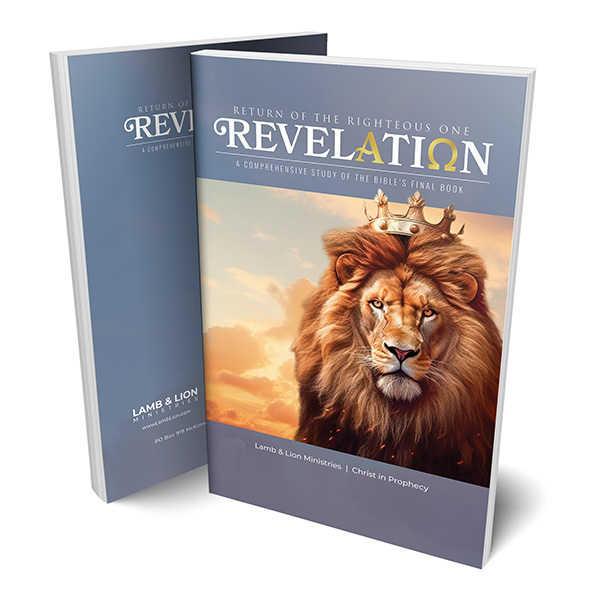
Narrator: Lamb ∓ Lion Ministries is pleased to offer an updated verse-by-verse expository study of Revelation. Based on Dr. David Reagan’s original Overview of Revelation, this new study guide contains QR codes to digitally remastered audios recorded by Dr. David Reagan himself. It steps through the entire Book of Revelation in an easy to follow manner. The expanded and improved study guide is filled with colorful graphics and bonus material to enrich your own study of Revelation. The full color printed copy of The Revelation Study Guide can be yours for only $25, and that includes all the links to the online audios at no extra charge. Just call the number on the screen or visit our online store. If you prefer, you can download the study guide itself from our website for $10. You’ll find the Lamb & Lion Ministries Revelation Study Guide to be a valuable aid to your study of God’s Prophetic Word.
Closing
Nathan Jones: You often hear us refer to the return of Jesus as our Blessed Hope. That is a title taken directly from Titus 2:13. Ours isn’t a hope that is based on a wistful wish or a forlorn and fading dream, our Blessed Assurance is that Jesus has come, He has paid the price for our sins and promised us eternal life, and He is coming again for all who have trusted in Him.
Tim Moore: Each of us has ups and downs in this life, Jesus affirmed that as His followers, we will have trouble in the world, but we can have peace that passes human understanding, because we know that He has overcome the world. The future described in Revelation will involve troubles, too horrible to imagine, multitudes will perish as God’s wrath is poured out on the world, Tribulation saints will be martyred in numbers too great to contemplate, but Jesus will triumph over our eternal foe and be glorified in all the Earth.
To paraphrase the great Bill and Gloria Gaither song, “Because he lives,” and because He has promised that we who are His will live with Him forever, we can face tomorrow free of fear, because we know he holds the future, our life is worth living.”
Or as Horatio Spafford testified:
Though Satan should buffet, though trials should come,
let this blessed assurance control:
that Christ has regarded my helpless estate,
and has shed His own blood for my soul.
Oh Lord, haste the day when my faith shall be sight,
the clouds be rolled back as a scroll;
The trump shall resound and the Lord shall descend;
even so, it is well with my soul.
Amen, and Godspeed!
Donate
Narrator: Christ in Prophecy is made possible through the faithful and generous support of viewers like you. Please consider making a donation to Lamb & Lion Ministries, so that we can continue broadcasting the message of Jesus’s soon return. Thank you and God bless you!
End of Program
