

How can Christians prepare for the Rapture and spiritual warfare? Find out with guest Todd Hampson and evangelists Tim Moore and Nathan Jones on the television program, Christ in Prophecy!
Air Date: May 2, 2026
Video Links
Todd Hampson
Prophecy Pros
Prophecy Pros Academy
Future Hope
Timbuktoons
Resources
To order, call 1-972-736-3567, or select the resource below to order online.
Transcript
Tim Moore: Shalom! We’re glad you’ve joined us today for Christ in Prophecy. We have a very special guest with us today. Todd Hampson is a gifted author and artist, half of the “Prophecy Pros” team, along, of course, with Jeff Kinley, and a good friend of Lamb & Lion Ministries.
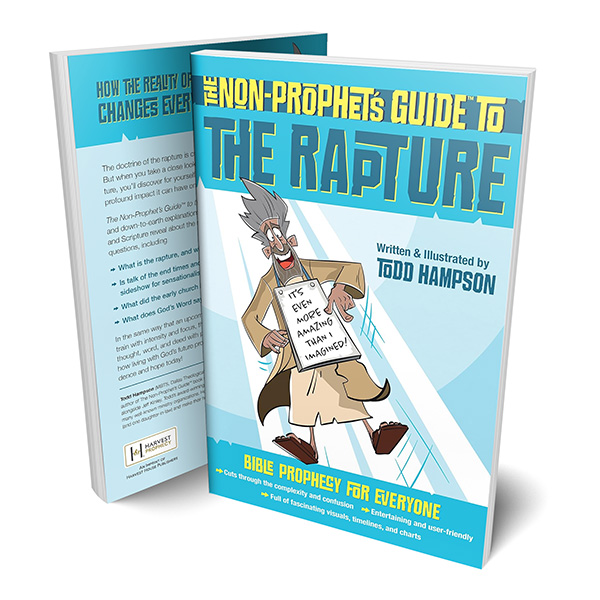
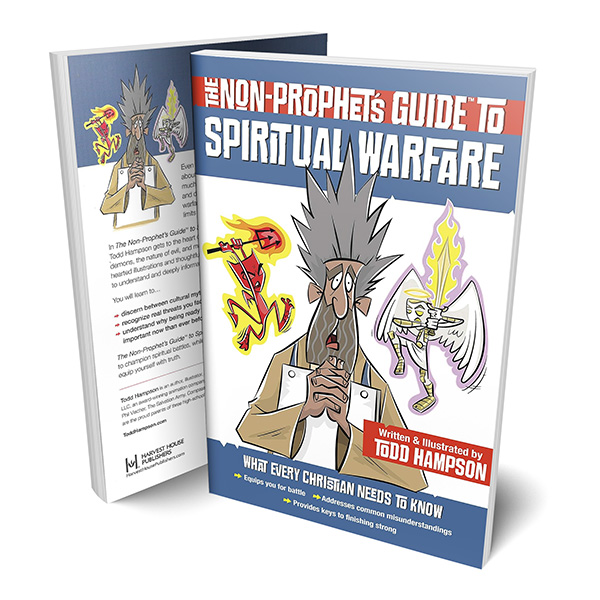
Nathan Jones: In addition to speaking all around the country, hosting podcasts, engaging TV and radio audiences, and running a successful animation company, Todd has somehow found time to write an entire series of “The Non-Prophet’s Guide” books. We’ve featured several of them here at Lamb & Lion Ministries, and today we’re excited to discuss the latest two with Todd himself.
Part 1: Todd Hampson Interview
Tim Moore: Well, Todd, we could go on and on by way of introduction, but we are really grateful for your gifted insights, your friendship, and your willingness to join us today. So again, welcome back to Christ in Prophecy.
Todd Hampson: Likewise, I’ve really been looking forward to joining you two again, and we’re just old friends. It’s always great to get together, whether we’re bumping into each other at a conference or whether I’m joining you on this show, it’s great to see you two again.
Tim Moore: Well, always a blessing to us, and I know it will be to our viewers today. So let’s jump right back to the beginning. Well, maybe not quite that far back, but let’s at least go back to your beginning, Todd. When did you realize that God had gifted you both with artistry and insight, and how did He motivate you to engage in serving Him by sharing those gifts with others in so many outlets?
Todd Hampson: Yes, I mean, ever since I was a kid, I’ve been good at drawing and stuff like that. I went to art college and started a company called Timbuktoons, where we produce animation for Christian ministries and that sort of thing. And honestly, I just thought that was my main gift set that I would use to serve the Lord, kind of helping good ministries have good media and good illustrations and that kind of thing. And so, of course, all along the road, I had a love for theology. And then more recently went seminary, I went to Dallas Theological Seminary. So I have the theological background, and that’s always been in my wheelhouse, but I always thought the Lord would just use it for producing videos. But He was really preparing me, I see now, for writing books and illustrating books and now even speaking. So He was just preparing me all along to do what I do. But I’ve always had a love for theology, always had a love for art. So this is kind of the combination of the two.
Nathan Jones: Well, that combination has come out in The Non-Prophet’s Guide series that you did, which is absolutely fantastic, because you get Bible prophecy simplified so that anybody could understand. But you also have these wonderful animations of this guy called the Non-Prophet. I’ve got Rapture, Spiritual Warfare. This is my own personal collection. Heaven, we’ve got Daniel, we’ve got Revelation, we’ve got The End Times. Brother, I’ve got other books too. You do an amazing amount of writing and drawing. And how do you come up with it all? I mean, why the Non-Prophet series?
Todd Hampson: That’s a great question, and really, you hit the nail on the head. I wanted to develop something that puts handles on it, that makes it easier to understand. Because what I was noticing is that even though when I read Scripture and I look at the world and I say everything we read about for the End-Times, we’re seeing the stage being set for this time, most believers I knew are confused by the issue. Most churches I would go to water down or don’t even address prophetic themes or eschatology or anything about the End-Times. They just kind of, you know, simmer down to the least common denominator and what everybody can agree on without any arguments.
But the whole book of the Bible, from Genesis to Revelation, was given to us as one complete story. Every believer should know how the story ends. So I wanted to use this goofy character, the Non-Prophet, and he gets prophecy wrong in the books, but I wanted to use him kind of as the comedy relief and basically create a book that I would’ve loved to have had as a younger person or as a young adult or a new believer to help me understand these things in a concrete, literal way.
Tim Moore: I think one of the secrets to your success, even as a gifted communicator, is you understand the power of story. And so whether it’s putting together a cartoon, a short form communication tool, a novel, or a story, you realize that the Bible is a narrative and that woven through it are prophetic revelations of God, His character, and His plan for the ages. And so you’ve done the same thing by taking that story and making it very understandable and again, very appealing.
I’m an adult; I love to read this. Even though some of the artwork and the graphics would appeal to a young person, as you said you would’ve loved to have something like this, it still is fun for me to read because it conveys information I’m familiar with, but in a new way. And I’ll just say, while all the other books that you’ve written deal with topics that we address frequently, your latest title is in the center of our wheelhouse: The Rapture. And we would observe that faithful Christians have looked forward to that Blessed Hope for almost 2,000 years. So before we dive into the book itself, Todd, what evidence do you see that we are on the cusp of hearing a trumpet and the voice of the archangel, and perhaps hearing “come up here” as we rise to meet Jesus in the air?
Todd Hampson: Oh, I would welcome that today. As much as I’m enjoying this, I’d welcome the Rapture even more. So yeah, I mean, when you look around at the world, Hebrews 10:25 says, “to not neglect the assembling of ourselves together, all the more as you see the day approaching.” So we’re told right there that if we’re watching carefully and reading the Scripture, then we will be able to see the stage being set for The Day of the Lord and the day of the Lord’s return. But we’re told, of course, nobody knows the day or the hour.
So how we see the day approaching is we look at the conditions of the world, and what we see is that there’s multiple trend lines. And some of the biggies that I look at are, obviously, the epicenter of all Bible prophecy is Israel. So all things related to Israel, with that, the global rise in antisemitism that we’ve seen just explode in the past few years. I believe all of that is connected to End-Time prophecy.
And then also along with that, just the Ezekiel 38 alliance that’s in place, the push for peace in the Middle East. I mean, we just have a committee of peace that just came together. I mean, you can’t script this stuff. It’s almost like people are reading the Bible and saying, “Hey, let’s lay the groundwork for everything that’s going to happen in the future tribulation period.” And that’s kind of the exclamation point, is just the convergence of all these things in our day.
The three of us are privileged to know some people who we stand on their shoulders, you know, Dr. David Reagan, Tim LaHaye, other people who preached the same message that we’re preaching years ago, 20, 30, 40, 50 years ago, but they didn’t see a fraction of what we see today. And at the same time, most of the bride is asleep and not even noticing it. So it’s our job to wake up the bride, to shine a light on these conditions that are converging in our day, to let people know that means that the Rapture is that much closer, and that should excite us.
Tim Moore: Amen.
Nathan Jones: And you bring up a really good point about the bride is asleep. You know, of all the promises in Scripture, Satan’s going to love to try to discredit the one about the Rapture, or at least, you know, make it so the Church doesn’t understand that the imminency is coming. You even have little charts and graphs in here that even help us understand imminency. Well, too often it’s been successful at that. Satan’s deceived the Church. Why do you think there’s so many professional Christians who just don’t seem to care anything about the Rapture? They’re the scoffers that Peter warned about.
Todd Hampson: Yeah, I think there’s multiple reasons, but it all stems back to it’s spiritual warfare. Another topic we’re going to talk about is Satan wants nothing more than for believers to get fuzzy on our origins and our destiny. If he can convince the Church that Genesis is allegory and that the end of the story isn’t worth looking into, then he’s gutted the Scriptures of much of its power.
As you mentioned earlier, the Bible is one complete story. Nobody goes to their favorite movie and walks out before the ending and just says, “Oh, it’ll all work out somehow.” No, you stay for the ending. You want to know what the ending is. And using that story concept again as well, we just happen to be at a particular moment in the story. Believers in the first century, before the coming of Christ, were in a different era of the story. So understanding where we are in the story both helps us to look back in celebration of what Christ has done, and we also look forward in anticipation to His return.
Every good coach or leadership book or anything like that that you read is always going to talk about the importance of anchoring yourself to some goal or some future event. And that’s what we have in the Rapture. It anchors us; it pulls us forward. We’re anchored to, as Jeff says, we’re anchored up. We’re anchored to something that draws us forward. Anticipating the Rapture, it’s our Blessed Hope. It’s the thing that encourages us and gives us an ability to push through the tough things in life, whether it’s in our personal life or in just the conditions of the world. So it’s a key thing that the enemy has done a great job getting believers’ eyes off of.
And another way that he’s done that is through just kind of the seeker-sensitive church model, which may have had some good intentions in the beginning, but really flipped the paradigm. Instead of equipping the Church to understand Scripture and send them out, we’ve dumbed down the Gospel as much as we can to bring as many people in, but then we’re not taking them deeper. So those and several other things: sensationalism, infighting, you know, friendly fire, all these things have caused people to get their eyes off the ball.
You know, again, we just finished football season with the Super Bowl and all that. So just using that analogy, we should be looking for the touchdown. We should be looking for the end zone. But most of the Church is acting like we just get to stand here on the 50-yard line and wait for something to happen.
Tim Moore: You know, I love what you say about the Blessed Hope. I have a dear friend who was a POW in Iraq 35 years ago. He’s been on this program, Rob Sweet. And he would tell you that the thing that kept him going, it was a short period that he was a prisoner. Prisoners in Vietnam were there sometimes for years, but the thing that kept them going was the hope that they would be restored, that they would get to go home. And so hope is so powerful. Those who give up hope or have no hope, they quickly decline and oftentimes die. And that’s why the Lord says that His return, the promise of the imminency of the Rapture, is our Blessed Hope.
Well, Todd, I have always loved your character, the Non-Prophet. He’s a real hoot to me. He’s dressed like a legitimate biblical prophet, but his answers and sometimes his insights are obviously a bit skewed. As you said, he’s made to make fun, if you will, at some of the false ideas. And I’m actually reminded of a podcast I recently saw with Justin Peters and a man who confessed to being a false prophet after he had escaped the cultism of the Bethel Church.
And so you do such a great job of poking fun at anyone who would falsely claim to have a word from God. And yet the distinction is that we, all three of us, believe that God has spoken through His authorized prophets, and that every promise in Scripture dealing with prophecy will be fulfilled in glorious detail.
Todd Hampson: Amen. I mean, that’s the beauty of it. Fulfilled prophecy is the apologetic or the evidence that convinced me that the Bible was from God. And yet unfulfilled prophecy is what we have to look forward to. And you know, roughly 28% of the Bible was prophetic when first given through those prophets, and 80% of that has been fulfilled. So that’s a huge down payment that should give us great confidence that God is a promise keeper, that He finishes what He starts, that He means what He says, and He says what He means.
And thankfully, yes, we have a closed canon. We have all 66 books; we have all the information we need. The Holy Spirit still guides us and illumines our heart to God’s Scriptures and makes us sensitive to His movements and that kind of thing. But all the information we need, that we’ll ever need, we call that the sufficiency of Scripture. It’s all in those 66 books of the closed canon of Scripture.
Tim Moore: Amen.
Nathan Jones: We love to say that when the Rapture happens, that we will know the season of the Lord’s return. And sometimes people write Tim and me and say, “Well, is that the fall or this spring, or what exactly do you mean?” Your book talks about the season of the Lord’s return. What is that, and how do we know that we’re living in it?
Todd Hampson: Yeah, that’s a great question. And it relates a little bit to what I was talking about earlier, just that convergence of all these conditions.
Nathan Jones: Why don’t you give us some examples of some of these signs that are converging together?
Todd Hampson: Yeah, absolutely. I mean, some of the key signs, I think, you know, Israel becoming a nation in 1948 was the super sign of the End-Times. And by the way, it validates the plain reading of Scripture. When God says something’s going to happen prophetically, you don’t have to allegorize it; you don’t have to wonder what it means. It means it’s going to happen.
I have a book right behind here on my shelf from 1946 from a seasoned Bible teacher at a seminary, and I forget where the seminary was, I think it was in Texas, but he has a book called God and the Jew. And one chapter in there sums up the book, and he says, and he’s a replacement theologian, he says in the book why there will never be a national restoration of the Jewish people to their land. Two years later, there was a national restoration of the Jewish people to the land.
So that begins; that’s the super sign. And then, honestly, if you look carefully through that time, there’s been a constant, rapid uptick, almost like the tide coming in further and further as time goes on, of these other signs. The Ezekiel 38 conglomeration of nations are all in position, the antisemitism that I mentioned earlier, the push for globalism. There’s been a push for globalism since about that same time when Israel became a nation again.
And then on the digital side, you have, you know, cryptocurrencies and these massive data centers. And of course, now AI is on steroids and is rapidly producing things that we never even thought we’d see in our lifetime. So from technology to geopolitics to culture, I mean, the coarsening of culture, Paul said that there’d be lawlessness in the last days, and he lists a bunch of other characteristics that are all there as well.
And when you look carefully at that, I used to think it just meant street-level lawlessness, but when you look at it carefully, it means there’s going to be lawlessness from top to bottom, from the highest level of government to street level. And we’re seeing that in our day.
So when you look out at the world, apart from using the biblical grid, things just look chaotic and random. But when you hold up the Scripture, the prophetic Scripture, and see what the Bible says about the End-Times, we’re seeing all of that come into play in our day. And that should excite us and let us know we are in the season of the Lord’s return. We don’t know the day or the hour, but as I mentioned earlier, we can see that day approaching.
Tim Moore: I think it’s important to realize that as much as we can perceive that the season of the Lord’s return is drawing near, Satan can perceive the same thing. He knows Bible prophecy as well as us. He has experience with the Lord Himself. I mean, he knows Him personally in a way that we have not seen face to face. But Satan cannot discern the future. All he can do is try to thwart God’s will and deceive the nations.
We’re going to shift gears to your book on spiritual warfare, and I’ll just observe that geopolitical commentator Gordon Chang once said, “The surest way to lose a war is to refuse to recognize that you’re in one.” I think that’s a great quote. And many Christians seem oblivious to the fact that we’re in a spiritual war, a spiritual battle every day. So what evidence do you see that the forces of good and evil are battling it out in the spiritual realm and that those hostilities are actually spilling over into our present reality, Todd?
Todd Hampson: That’s a great question. And the quote, that’s a fantastic quote, and that reminds me of a quote I heard from a World War II pilot who they said, “Well, you know, when you’re doing night raids flying over Germany to drop bombs,” they said, “how in the world,” this is obviously before modern technology, they’re like, “how in the world do you know that you’re over the target?” And he said, “Easy, when they start shooting back at me.”
So I think that analogy fits the quote that you said as well, in that we know that there’s spiritual warfare because we’re over the target and we’re being fired at. The Rapture is under attack. Dispensationalism is under attack. Inerrancy is under attack, again, in subtle ways. I mean, all these things that we hold dear; the authority of Scripture is under attack. The Old Testament, where people are saying detach and unhitch from the Old Testament. I mean, what kind of insanity is this coming from within the Church?
So I think that’s one big indicator, is that you expect there to be criticism from nonbelievers. And we don’t judge them. They don’t know the Lord yet. They’re not born again; they don’t have the Holy Spirit in them. So we try to witness to them. But these attacks are coming from within the Church. And one of the things we see in the last days is a great apostasy. So that goes hand in hand with it.
Also, I think another thing that we see that is very clearly, overtly spiritual warfare is the rise in antisemitism and the hatred for Israel. Even horrible teaching like replacement theology, that the Church has replaced Israel. All these things have crept into the Church. So Satan, as you mentioned, he’s very smart. He’s been around for thousands of years. He knows all the tricks, he knows how to infiltrate, and that’s what he does best. And I think that’s more dangerous; the attacks coming from within the Church are even more dangerous than any attack that could come from outside of the Church.
Tim Moore: Now, they’re certainly more hurtful. I’m not surprised when I get attacked by someone who is a non-believer, but just like Peter at one point became a mouthpiece for Satan and Jesus had to say, “Get thee behind me, Satan,” speaking to Peter. It’s very hurtful and disappointing when other Christians sometimes are becoming mouthpieces of deception. I’ll just say that.
Nathan Jones: Yeah. When it talks about deception in the Bible, especially Luke 21, Matthew 24, it’s interesting that the number one sign that Jesus gave was a manifestation of false prophets and false teachers in the End-Times. Watch.org, Watchman Fellowship says that in these days there’s a thousand cults and false religions kind of drowning out the Gospel message. And so that leads us in your book here. What do you advise Christians to do to be able to distinguish between what’s truth and what’s false?
Todd Hampson: Yeah, great question. I mean, I think you’ve got to know the Word. I mean, the Sword of the Spirit, you know, it is the Word of God, that is our key weapon. And I think way too many believers and even non-believers who get caught up in these cults have a surface-level knowledge of the Bible. I mean, they’ve never been taken deep. And that’s what I–When I mentioned earlier that there’s been some dangerous things happening where we’ve watered down truth and we’re not equipping the Church.
That makes them susceptible to error and to getting sucked into these cults. So really, it comes back to good old-fashioned Bible study and believing in the key doctrines of bibliology, that the Bible is inspired and inerrant and authoritative and sufficient. That everything we need to know is in here. There’s no extra knowledge that has to come that fixes something in Scripture. Everything we need is in the Bible, and we really need to teach it systematically. I think that’s a great need of the day, to take people deep in the Word.
Tim Moore: I think it is too. Obviously, we talked a lot about Satan in regard to spiritual warfare. I think one of the manifestations of Satan’s desperation to discourage, deceive, defeat, and even damn the world and distract Christians at the very least, is this increase in spiritual warfare, which is why I’m so grateful for this new book that you’ve released.
And we touched on a moment ago sort of the friendly fire that we sometimes come under. Like I said, you expect your enemies to be shooting darts at you. You don’t expect folks within the congregation to be the source of fiery darts, but sometimes Satan is able to deceive us into doing that.
So how, Todd, should Christian’s understand all these battles that are raging, and how should we armor up and encourage other believers in Christ to do the same?
Todd Hampson: Yeah, I mean, the clearest place we get some equipping for that specifically is in Ephesians chapter 6. And in that book you mentioned, I have one chapter for each of the pieces of armor. And that was really helpful for me to work through those and do some research and stuff like that. I learned a lot about each of the pieces of armor and how we apply them. And also, by the way, Jesus modeled each and every one of those for us so we could see how He lived those out in real life.
But they are given to us to protect us. And it starts with the Belt of Truth. You know, we have to know what truth is. We have to believe there’s truth. And by the way, we find later that the Word of God, the Sword of the Spirit, is sheathed in the Belt of Truth. So truth holds everything together. You know, the Breastplate of Righteousness fits into truth.
Then, of course, we’ve got the Helmet of Salvation. God’s given us ways. He’s equipped us to protect our thinking, to protect our emotions, even the Shield of Faith for the things we can’t quite figure out in this world. I mean, every one of us who’s lived a Christian life long enough has faced trials or struggles or lifelong struggles that we don’t know the answer to or don’t know why the Lord allowed it into our lives. But we hold up that Shield of Faith and say, “But I trust you, Lord; one day it’s all going to make sense.”
And we’re not given everything in Scripture. You know, I mentioned earlier that Scripture is sufficient, meaning everything we need to know is there, but we still have a lot of questions that we won’t have answered until we get to Heaven. So we raise that Shield of Faith.
And the shoes of the preparation of the Gospel of Peace give us firm footing. You know, the Roman soldiers’ sandals were designed for any terrain: wet, dry, sandy, muddy, you name it, it was custom fit to work in any of those environments. So God has given us firm footing in our salvation and firm footing to present salvation to other people as we march through this life.
Tim Moore: Yeah, obviously, Ephesians 6 does give us the outline of the armor of God. I find it interesting, Todd, being a military guy, that of all the different pieces of equipment that Paul mentions, most of them are defensive in nature. Only one, the Sword of the Spirit, and that is the Word of God itself, is what you would call an offensive weapon. Everything else is defensive for us.
Todd Hampson: Yeah, that’s a good point. Everything else is designed for defense, and the Roman sword, and actually it was called a gladius. And when we think of swords, we think of like big, long Braveheart swords, but the Roman sword was actually a short sword, almost like a big knife. And it was built for close hand-to-hand combat. You know, there were other things they tried to use from a distance, but those are designed to be used in a skillful way, in close combat.
So that kind of highlights to me the fact that when the enemy attacks, it’s personal, it’s close, it’s infiltrative, it’s tricky, it’s sneaky, and it’s hand-to-hand combat. It’s not something that’s distant from us. So the more we want to be ready for that, the more we have to understand the Word of God. And again, this is another one of the key areas that Jesus modeled for us. And when He was sent out into the desert to be tempted, every single time Satan tempted Him with something, Jesus came right back using that sword, quoting Scripture to the enemy. So that makes it clear that we need to know Scripture. I know I’m harping on that quite a bit, but we need to memorize Scripture, we need to study Scripture, we need to be in a body of believers.
That’s another thing with the Roman army, especially with the shields. A Roman soldier out on his own was very susceptible, but when they came together and linked shields, they were nearly unstoppable. They had many formations. One of them was called a tortoise formation, where they had all sides blocked around and the guys in the middle held the shields up. So no matter what the enemy was throwing at them, you know, fiery arrows, rocks, you name it, they could march forward in confidence because they were working together. And I think that’s a beautiful picture of how believers like what we’re doing here today, we’re serving together, trying to serve the Lord to make an impact for the kingdom.
Nathan Jones: Todd, as an animator, you obviously do a lot of work with youth and children. I think when my kids were young, we put them in Bible Drill, and for three years they competed, they had to memorize all these verses. And you compare that program to some of the other programs that were more about crafts and social. Those kids, as they grew up and went through high school, seemed to not know anything about the Bible. But I was so proud of the Bible Drill students because they could always go back to a verse to defend what they believed.
So Todd, how do you see these books working with the youth? I know a lot of parents out there wondering, how can I equip my kids in the Full Armor of God? And I think you’ve got a resource right here.
Todd Hampson: Yeah, absolutely. And I have one children’s book. It’s a book for young readers, kind of elementary age, but all of the Non-Prophet’s books, they’re built for adults. But I’ve had over and over again, many middle school small groups studying them, high school students, college students, all the way up. I think the oldest lady I met that had read some of my books was 92. So from 10 or 11 to 92, these books are for you. But I do think it’s important, and as you said, teaching them Scripture, and I think you have to model it as you teach it. And that’s a dangerous one-two punch for the enemy because that’s how you change a generation.
Tim Moore: Obviously, I think we’ve touched on the fact that too many Christians today are what we would call under-armored. And I’m not referring to the sportswear that carries that brand name, but they really have not armored up. And I also think too many Christians want to protect their children from the battle that is raging, instead of training them for battle and telling them you are designed to enter the battle on behalf of our Lord, our great commander. He has won the victory, but it is our purpose here on this Earth to join the fray and actually serve Him boldly because we are indeed armored up and have that Sword of the Spirit.
Todd Hampson: Amen. You know, I heard somebody say, “Why are we afraid of the lions if we’re raising lion slayers?” That should be our attitude with our children. They’re so equipped, and we’ve poured so much into them that they’re going to be ready to meet the need of their day. We’re here sovereignly by design at this time, and so is the next generation. And God needs them. I pray the Rapture happens as soon as possible, but if it doesn’t, we need to pass that baton to the next generation so that they’re equipped and they have that firm footing as well.
Nathan Jones: Well, Todd, our viewers can call the number on the screen or visit our website at christinprophecy.org to order any of your books that we’ve highlighted today. And also, how can they follow your ministry?
Todd Hampson: Probably the simplest way is they can just go to toddhampson.com, and there’s several other initiatives I’m involved in, but you can link to all of them from there, toddhampson.com.
Tim Moore: You know, Todd, I entitled this episode, “The Non-Prophet Prophetic Voice,” that being you. And while none of us would claim to be prophets in the biblical sense, you are certainly a prophetic voice along with your Prophecy Pros partner, Jeff Kinley.
Todd Hampson: Yeah, it’s been a privilege to partner with him. You know, strategic partnerships are key, and using that analogy I used a few minutes ago, when soldiers can link arms and have a common mission, I think you can go further faster. And that’s what Jeff and I have been able to do. We have a few new initiatives: a Prophecy Pros Academy and a Future Hope Initiative where we’re trying to reach the next generation. So a lot of exciting things happening.
Tim Moore: Well, on that note, actually, we’re very excited about some of the projects you guys have been working on together. So I’d like to invite you to join us again next week along with Jeff to discuss what the Lord is doing in and through your ministry.
Todd Hampson: Awesome, I look forward to it. Thank you so much for having me on.
Closing
Tim Moore: Well, folks, we’ve run out of time for today, but we’ve given you a clear understanding of the battle that is raging all around us and the urgent call to armor up and join the fray.
Nathan Jones: No Christian is immune from Satan’s fiery darts, but every Christian is called to engage in the timeless battle. Our victory is certain, but there are countless souls hanging in the balance.
Tim Moore: To paraphrase the fifth verse of “The Battle Hymn of the Republic”: “As Christ died to make men holy, let us live, and die to self to make men free, While God is marching on.”
Join us again next week for more battle training! Godspeed!
End of Program
