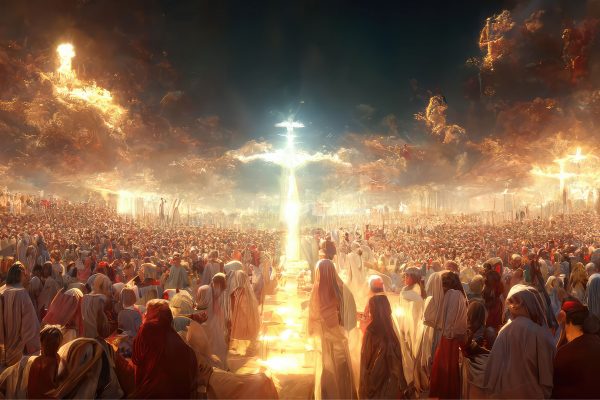

Behold, He Comes!
And Every Eye Will See Him
By Tim Moore
“Behold, He is coming with the clouds, and every eye will see Him…” (Revelation 1:7)
The Rapture will bring an end to the Church Age, and the Tribulation that quickly follows ensues on Earth. For every born-again believer in Jesus Christ (living and dead), the Rapture is the imminent Blessed Hope we eagerly await.
But there is still more to come after we have “shuffled off this mortal coil” and been transformed in the twinkling of an eye. As every showman would say, “You ain’t seen nothing yet!”
Perhaps that is a bit flippant and brash, for certainly Jesus’ coming for His Bride and our welcome into the Father’s house are what Hamlet also described as “a consummation devoutly to be wished.” The Rapture itself represents a clear and looming delineation between those who will meet Jesus in the air and those who will be left behind to suffer as God’s wrath is poured out.
Let us turn our attention to the next great prophesied intersection of Heaven and Earth as described in Revelation 19:11-16—the Second Coming.
Heaven Opened
There are multiple instances recorded in Scripture when God sent angelic messengers to interact with people on Earth. There are also clear Christophanies recorded in the Old Testament, when there can be little doubt that the Son of God appeared in pre-incarnate form. Others would argue that the Father Himself offered glimpses of His Shekinah glory to select Old Testament saints.
In other rare instances, throngs of angelic beings were visible to mortal men and women—either in dreams like Jacob’s or as part of the heavenly choir the shepherds around Bethlehem saw and heard. But never before has Heaven thrown wide its gates for its glorified population to descend to Earth en masse. That is what John describes in Revelation 19. Yet the focal point of John’s narrative is not the saintly army; it is the King who rides forth at the head of that throng.
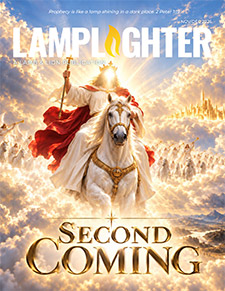
Then I saw heaven opened, and behold, a white horse, and He who sits on it is called Faithful and True, and in righteousness He judges and wages war. His eyes are a flame of fire, and on His head are many diadems; having a name written on Him which no one knows except Himself, and being clothed with a garment dipped in blood, His name is also called The Word of God (Revelation 19:11–13).
In this scene, Jesus is not depicted as a suffering Servant or a gentle Lamb. He appears as a mighty Warrior—the royal Lion of Judah. His majesty and glory are fully manifested in His appearance, and His anger toward the rebellious and grace-rejecting world is evidenced by His fiery eyes and readiness to wage war.
I have recounted this scene multiple times, but I always thrill to read this passage while standing on the Mount of Olives overlooking the Eastern Gate in Jerusalem. That is because I can see all this action taking place in my mind’s eye. I can practically hear the thunder of hooves as Jesus leads His vast army back to Earth to establish His promised reign. And I am overwhelmed to realize that I will be a part of that glorious throng.
Knights in White Linen
In medieval times, knights wore elaborate suits of armor. Not only did the heavy metal garments provide a measure of protection against swords, spears, and arrows, but they conveyed a status and stature that came with the title.
Glorified saints will have no need for such defensive attire. Instead of heavy armor, we will be clothed in “fine linen, white and clean” and riding white horses. Evangelist Don Perkins likes to tell folks that he has already picked out a name for his horse—Nellie! I will readily admit that although I hail from horse country (Kentucky), my experience with horses is pitifully limited and decidedly mixed.
I still have no doubt that the horse I will ride will be as magnificent as Black Beauty, as swift as Secretariat, and as faithful and smart as Silver. No rider will be thrown that day as we follow our Commander back to Earth. And even our own raiment will remain unsoiled.
The fine linen itself represents the righteous deeds of the saints. In other words, after all the wood, hay, and stubble in our lives are burned away, only gold and precious stones will remain. I have long said that I hope my righteous deeds will produce enough fine linen to cover me properly. Yet even those righteous deeds credited to me will be a reflection of the righteousness Christ enables me to exhibit. In other words, the credit even for those righteous acts will bring glory to Him.
Yet, not every garment in that vast array will be unbesmirched. One will be forever stained blood-red.
Christ’s Everlasting Glory
Although He will purify His saints, wiping away their tears and forgetting their sins (of commission and omission) forever, Christ will always bear the evidence of His great love and sacrifice.
We are told that after His resurrection, Jesus invited Thomas to put his finger into His hands and his hand into His side (John 20:27). Even in His glorified body, those manifestations of the agony Jesus suffered on the Cross were still evident—not because they were marks of shame or lingering pain, but because they continued to testify to His glory.
The same is true of the robe He will wear as He leads His army forth from Heaven. The Anointed One whom John described as the Word—who was with God and was God from the beginning—will wear a robe dipped in blood. Some have speculated that this blood represents reprobate blood spilled as judgments were poured out during the Tribulation, as described in Isaiah 63:1-3. But as Jesus returns to Earth in glory (to personally tread the winepress of God’s wrath), I am convinced that this represents His own blood—shed for the forgiveness of sins as He endured the wrath of God on the Cross.
While I look forward to wearing clothes that are unblemished, the indelible stains on Jesus’ own garments should remind us that in this life, even our wounds and scars can testify to His grace. Do you have a thorn like Paul’s? I do, but His grace is sufficient. Do you bear evidence of bumps and bruises that He has helped you overcome? More evidence of His faithfulness as you persevere. Are the signs of age and mileage more obvious each day in your body of corruption? These too bear testimony to His steadfast provision—and the anticipated promise of your homegoing.
Just remember the testimony of Joseph: what was meant by Satan and his unwitting minions for evil against you, God has orchestrated for good (Genesis 50:20). Or, as Paul explained, “God causes all things to work together for good to those who love God, to those who are called according to His purpose” (Romans 8:28).
Our Warrior King
The description of Jesus, the Word of God, that John records in Revelation 19:15-16 belies the claim that the Rapture and the Second Coming occur as a single event. We know that when Christ comes for His Church at the Rapture, He comes as a Bridegroom for His Bride. We will meet Him in the air—with the “dead in Christ” rising first, and those who are alive following in the twinkling of an eye.
He will take us to His Father’s house, where we will dwell with Him in the place He has prepared for us. And we will celebrate the Marriage Supper of the Lamb—the title given to the suffering Son of God who redeemed us by His own blood.
When He returns to the earth, we will follow after Him as described above. And His demeanor will not convey the eager love of a Bridegroom, but the indignation of a King. In fact, John’s description is of a Warrior King returning to set right what has long been tolerated.
Parable of the Landowner
In Matthew 21, Jesus told of a landowner who planted a vineyard and rented it to tenants to tend. At harvest time, he sent servants to receive his portion. But the tenants beat and killed the servants, along with a larger group he sent to advocate his interests. Finally, he sent his own son, saying, “They will respect my son.” But the evil tenants conspired to kill the son and seize his inheritance.
This parable is a dramatic picture of God’s relationship with the unrepentant world. “The earth is the LORD’s, and the fulness thereof; the world, and they that dwell therein” (Psalm 24:1, KJV). He has every right to ownership of every square inch, every living creature, every image-bearing person. And His only begotten Son has the same claim. To quote Abraham Kuyper, “There is not a square inch in the whole domain of our human existence over which Christ, who is Sovereign over all, does not cry: ‘Mine!'”
Yet evil men—representative of the entirety of the human race—conspired to kill the Son. They hung Him on a cross and buried Him in a borrowed tomb. They thought they had usurped God’s claim, tearing His fetters and casting off His cords. How wrong they were. How wrong all are who continue to flaunt their wickedness and hope that God’s indignation is never aroused.
Jesus’ question at the end of this parable offers a segue to the scene in Revelation 19: “Therefore when the owner of the vineyard comes, what will he do to those vine-growers?” (Matthew 21:40). Even the chief priests and elders answered rightly: “He will bring those wretches to a wretched end.”
Thus, in righteousness He will judge and wage war. Jesus will return as a Warrior King. John says, “From His mouth comes a sharp sword, so that with it He may strike down the nations, and He will rule them with a rod of iron; and He treads the winepress of the fierce wrath of God, the Almighty” (Revelation 19:15).
Who Is the King of Glory?
No longer meek and mild, no longer silent as He is led to slaughter like a lamb, no longer willingly absorbing the scorn and abuse of wicked men, Jesus will return to pour out vengeance. No man or woman can exhibit truly righteous indignation, but our righteous Lord will.
In short order, He will destroy the armies arrayed on the Plain of Jezreel (the Valley of Armageddon), merely speaking a word that will cause those wicked warriors to rot where they stand. He will set foot on the Mount of Olives overlooking Jerusalem from the east. As He begins walking toward the Eastern Gate, the valley containing Jewish and Muslim graves will split in two—with half moving toward the north and half moving toward the south. As He approaches the gate sealed by Suleiman to keep the Jewish Messiah out, the ancient gate will fly open so that the King of Glory might come in.
Lift up your heads, O gates, and be lifted up, O ancient doors, that the King of glory may come in! Who is this King of glory? Yahweh strong and mighty, Yahweh mighty in battle. Lift up your heads, O gates, and lift yourselves up, O ancient doors, that the King of glory may come in! Who is He, this King of glory? Yahweh of hosts, He is the King of glory. Selah (Psalm 24:7-10).
Then Jesus will ascend to the Temple Mount to fulfill the promise prophesied of Him: to reign from the throne of His father, David.
Our God Reigns
Ezekiel offered a prophetic perspective on the departure of God’s Spirit from the Temple. His Shekinah glory went up from the mercy seat over the Ark in the Holy of Holies to the threshold of the Temple, then to the courtyard outside, and then to the eastern gate of the Temple complex (Ezekiel 9:3; 10:4, 18-19). He then testified that the glory of God moved to the mountain east of the city (the Mount of Olives) before it ascended into Heaven (Ezekiel 11:22-24).
But Ezekiel also prophesied of the glorious day when the glory of God would once again fill the Temple. Coming from the east, the glory will return through the Eastern Gate to take up residence in the Temple once again (Ezekiel 43:1-7). That anticipated scene offers a preview of what is described in Revelation 19.
Soon after His return, Jesus will separate the sheep from the goats and initiate His Millennial Reign. Eventually, “every knee will bow and every tongue will confess that Jesus Christ is Lord, to the glory of God the Father” (Philippians 2:10-11). Those who have rejected Him will forever regret hardening their heart against the love and mercy of God.
John records a telling detail in his description of the Second Coming. He tells us, “On His robe and on His thigh He has a name written, ‘KING OF KINGS, AND LORD OF LORDS'” (Revelation 19:16). That title expresses the totality of His omnipotence. There is simply no created being who approaches His power, might, and authority.
There is no better response to Jesus’ impending reign than to worship our soon-coming King. The psalmists put it this way:
The LORD reigns, He is clothed with majesty; the LORD has clothed and girded Himself with strength (Psalm 93:1).
The LORD reigns, let the earth rejoice… (Psalm 97:1).
Even before John described the Second Coming, he recorded the praise that resounded in Heaven. Responding to a voice from the throne of God that said, “Give praise to our God, all you His bond-servants, you who fear Him, the small and the great,” the great multitude preparing to mount their war chargers cried out with the voice of many waters and many peals of thunder, saying, “Hallelujah! For the Lord our God, the Almighty, reigns” (Revelation 19:5–6).
Brothers and sisters in Christ, saints of the living God, we too can resonate with praise right now as we anticipate His soon return and His glorious Second Coming. Far from discouraged or distracted by the trials of this life, we can cry out: “Hallelujah! For the Lord our God, the Almighty, reigns.”