

What are the spiritual implications behind Iran’s war with Israel? Find out with guest Kurt Jefferson and evangelists Tim Moore and Nathan Jones on the television program, Christ in Prophecy!
Air Date: September 12, 2026
Video Links
Dr. Kurt Jefferson, Spalding University
Resource
To order, call 1-972-736-3567, or select the resource below to order online.
Transcript
Tim Moore: Shalom. Almost three years ago, terrorists from Hamas infiltrated Israel from Gaza and unleashed murder and carnage on a scale not seen in many years. Hamas, along with Hezbollah in Lebanon and the Houthis in Yemen are not new or unique in their hatred of the Jewish people. Haman and Hitler and many, many more have come and gone after attempting to annihilate the house of Israel.
Nathan Jones: But these three, Hamas, Hezbollah and the Houthis, have something else in common. They’re proxy forces for the malign nation of Iran. The outrage that occurred on October 7, 2023, was just the opening salvo in a conflict that has expanded to include the other players in this age-old war. But at the heart of it all, at least from a human perspective, is Iran, the modern nation-state that traces its roots back to ancient Persia.
Tim Moore: The spiritual implications of this present battle are undeniable. In order to impact the prophetic implications of this conflict and consider what Scripture tells us the future holds, we’ve invited a good friend of Lamb & Lion Ministries back to Christ in Prophecy.
Nathan Jones: Dr. Kurt Jefferson is a professor of political science. He specializes in leadership and transnational studies. Many of you will remember his dialogue with Tim last year regarding his book, The Wars of Israel. His insights are particularly timely, given what has been happening in the Middle East since late 2023 and, particularly, over the past several months.
Part 1
Tim Moore: Well, Kurt, I’m delighted to reconnect with you again, although I wish it could’ve been in the promised land of Kentucky once more!
Kurt Jefferson: Great to be back with you Tim and Nathan. Thank you very much and greetings from Louisville.
Tim Moore: Well, Kurt, we’ll have to tell our viewers here in a few minutes about the project we’re working on together. But first, let’s dive into today’s topic and discuss Persia: The Ancient and Intractable Foe. So right up front, let’s define what we mean by Persia, because most people alive today think that was an ancient empire in Bible times. So what and where is Persia?
Kurt Jefferson: Yeah, Tim and Nathan, I think when you think of the concept of Persia, first we have to understand that although it’s a historical term, it is a Western term that is not as old as the ancient Iranian or Persian people, going back to the onset of the Bible in the book of Genesis. So I think it’s important for us to understand that the inhabitants of the area that we basically call Iran today were descended from the son of Noah, Shem, in Genesis.
So the son of Shem was Elam, and this is where we get the group, the Elamites. And this is a group of people, of course, that later become known as Indo-Europeans. But it’s important for us to understand that the Persians are folks who descend directly from Noah and the grandson of Noah, Elam. So of course, this is where we get the idea of the Persians and this moves us into the idea of the Elamites who then are found in the far western part of what is modern day Iran.
Tim Moore: So really, it’s Iran or Iran that is the modern nation state, but the ancient empire all the way back to the Old Testament would be Persia.
Nathan Jones: Yeah. I dated a Persian back in high school, and if you said “I-ran” she’d slap you. It’s Iran.
Tim Moore: Iran.
Nathan Jones: So we want to make sure we get that right and don’t offend them. But Persia or modern Iran, what are they as Bible prophecy teaches us, in opposition to and what evidence do we have to even make that claim?
Kurt Jefferson: Well I think, Nathan and Tim, when you think about the group of Persians you start to go back to, first of all, one of the early mentions is in Genesis 14 with King Chedorlaomer of Elam and warring with five other kings in the Jordan Valley. And of course, this is where we see Abram step in and fight the five kings, Genesis 14. This is where you see the Elamites really warring against God’s people, Israel, right from the beginning.
And then later, as you get into the Book of Daniel, is really where we stop and see where the Persians emerge when we start to see Daniel who is sent into exile in 605 BC and he’s in Babylon. But then the dynasty of Cyrus, the Achaemenids, arrive about 550 BC and this is where you see the encroachment of the Persian Dynasty coming in. So it’s here that we start to see the Elamites that are being…going to be judged by God, but they’re also going to bring judgment on God’s people for the sin that they’ve committed.
This isn’t meant to be seen in my opinion, but also I think in biblical scholars’ opinion, as a God winking at what the Elamites are doing or what the Persians are doing. God is using them and allowing them to come and judge Israel, but at the same time, they will be judged for the things that they have done too. And we see this throughout history as the Iranian civilizations continue to develop and new kingdoms and empires come after this period as we head toward the time of Christ.
Tim Moore: I appreciate what you say about sometimes even these other nations were used as instruments of God’s judgment or we would say discipline of the nation of Israel, but He also held out that if any of those nations even dared to say ah-ha or lorded over the chosen people, the House of Israel, then He would have great anger toward them.
And you also point out that sometimes this ancient animosity goes all the way back to Genesis, whether it is the sons of Elam or even Esau and the Edomites that followed, he being a brother of Jacob who was renamed Israel. And there’s a sense of jealousy or covetousness that some of these other people groups, even their ancient forefathers, had a resentment of Israel, of the descendants of Abraham, Isaac and Jacob because they were chosen.
And it’s not like God said, well, all the rest of the world is cursed, but through Israel the rest of the world would be blessed. And yet over and over again, this animosity is fed by Satan out of a sense of jealousy or, again, covetousness.
And the title of this program today makes the claim that Persia or Iran is not only this ancient foe, but also an intractable one. In other words, there’s no solution, and we kind of see that bearing out in the news today. Is that a valid assertion though, scripturally and historically?
Kurt Jefferson: Yes, Tim, I think you’re correct. I think that when we look at what is happening today, but we go back into history that the relationship of Persia or the Persians or the civilizations that are being represented in the area, and that would include even beyond the time of Daniel going into the 250s, the 220s, we see the Medes, the Parthians in the north, the Medes in the central part of what is modern Iran. These are civilizations that are coming against all that God stands for, Yahweh.
So this is important, I think, for us to understand. It’s important to understand that this is history. This isn’t just spiritual, biblical material. The Bible is important. The Big Black Book needs to be opened by all to understand human history. And unfortunately, so many universities, other organizations want to put the Bible on the side burner and not open it to understand the foundations of this intractable problem, a problem that has seen centuries of warfare, centuries of hatred.
And so for me, yes, you see Cyrus being the one that authorizes the rebuilding of the Temple, working with then Zerubbabel and Jeshua, the High Priest. They’re the overseers of rebuilding this temple in 538 BC.
But Tim, you’re correct I think, in terms of looking at the foreign policy of Iran. It’s ironic that Iran and Turkey were the two states that were the first two Middle Eastern countries to support a partition plan that would give the Jews their own country, fulfilling the Balfour Declaration of November 1917. But it doesn’t mean that Iran still today, after the Pahlavi Dynasty, is not an implacable and intractable foe of the Israelis, which it is, especially after the terrorist regime comes to Tehran under the guise of a radical Shiism in 1979.
Nathan Jones: It’s interesting how we see that the Lord uses Iran to kind of punish Israel throughout history with Persia. But like you said, you had Cyrus who was raised up to allow the Jewish people to return to their land and rebuild their temple. And like you said, all the way up to the Shah, they were friends with Israel and yet, it seems to have turned around.
So what other historical evidence do we have to make the claim that Iran has been hostile to the House of Israel, either in their original Old Testament nations of Israel and Judah, during that long period diaspora maybe, or in the modern state dating back to 1948?
Kurt Jefferson: No, I think that’s a good question, Nathan. I think when you look at the chronology of the empires, you had empires with false gods, the Zoroastrians. You had a dynasty, the Sassanids there from 224 to 651 AD that was a Muslim dynasty. Of course, the Muslims came to Iran in about 633 AD. Islam comes onto the scene between the late 580s and the early 600s with the Prophet Muhammad. But you start to see Islamic empires come, the Umayyads and the Abbasid caliphate.
And then about the 12th, 13th century, you get the Mongols coming through and challenging Twelver Shiism. And what’s interesting about that is that’s where we get the term assassins, because the Mongols were the first group that could subdue the assassins coming out of the Shia environment.
But by 1501, about the same time as the Ottoman Empire is evolving up north in Turkey and then spreading down into the southern part of what was Western Arabia, I’m sorry, Western parts of the Middle East, you see the Safavid Empire. And historian Marshall Hodgson called the Ottomans, the Safavids in Iran, the Ottomans in Turkey, and the Mughals out of India, the Gunpowder Muslim Empires. And this is because the Safavids were able to use the canon to expand Iranian influence.
And also, this leads to the problem that Edward Luttwak, who’s an Israeli-American historian, worked for Ronald Reagan in what we now call the War Department back in the ’80s, has said, “We have a Shia Imperialism.” There’s a real animosity that the Western media doesn’t talk much about, and that is Sunnis versus Shia. Sunnis with Mecca in Arabia and along that Persian Gulf, which is relevant to this conflict today between the U.S. and Iran and Israel’s been a part of since early February.
Essentially, you have the Shia of the last 45 years trying to export Shiism. And it’s Shia, Iran exporting not only Shiism, but a kind of revolutionary brand of Shiism that is rooted within terrorism and other types of things using proxies, et cetera.
Tim Moore: Yeah, I think many Americans don’t consider just the history, not only ancient history, but I’ll dare say even more recent history. During World War II, the allied leaders met in Tehran because it was a safe, Western-leaning place where they could gather outside of the war-torn region of Europe and the Western Middle East, so to speak. So they met in Tehran. And from 1948 until 1979, Iran, the modern state that is in the place where Persia always existed, was friends.
You talked about the Pahlavi Dynasty, that was the Shah of Iran and he was leaning very definitely toward the West. Obviously, the United States and the CIA were very involved, but he was providing Israel with oil even when the other Arab nations would not. And of course, it was that revolution in 1979 infamously took many Americans hostage from our embassy there and kept them for 444 days that instigated this last, well, almost 50 years of a reign of terror from Iran, not just to that region, but to the rest of the world. And sadly and tragically, even to the people of Iran who I think we recognize many would like to be freed from that oppression.
But educate us today, Kurt. What is the frequently cited policy of the very mullahs and radicalized military leaders of Iran? From the Iranian Revolutionary Guard Corps to the Quds Force, this force that declares it’s going to liberate Jerusalem, using the Muslim term? What is their stated policy?
Kurt Jefferson: Yes, well as we saw after October 7, 2023, Tim and Nathan, we saw that there was kind of an inner ring of states that were hostile to Israel. And of course, those states had proxies, most of them fighting against Israel that were backed by the rogue regime in Tehran. So as a result, you had up in the north, Hezbollah, which of course is a radical Shia, basically a paramilitary group that serves as kind of an army within a state that it’s not really a part of, but yet because of its power, it is essentially more powerful than say, Lebanon.
But they, basically, started in 1985 with a foundational open letter that said their struggle would only end when the entity was obliterated. That entity, we know who that is, the antisemitism against Israel. Hamas, of course, has two charters. The Foundational Charter, this is the Palestinian resistance movement in Gaza essentially, but also in the West Bank, in Judea and Samaria as the Israelis call the area. And this is their charter in 1988. Article Seven said, “We’re going to kill all the Jews,” flat out.
They came back in 2017 with a slight revision, said, “We are at war with Zionism, not necessarily the Jews.” The problem with that double speak, in my opinion, is that you’re using terminology to say okay, we’re going to call the Jews by something else and they’re using the term Zionists. Well, aside from Jews themselves, who are Zionists, who else are you going to refer to?
There are Christian Zionists, absolutely, but they’re a small minority. There are a few Jews who are anti-Zionists, Orthodox, but they’re a very small minority. And of course, the term Zionism is a term that says we’re basically in favor of returning the Jews to their Jewish national home when the term was used, of course, in Palestine under the British Mandate in 1917. So this is a kind of a false statement and one that’s being used by them.
And then lastly to your point, Tim, about the Quds Force of the IRGC, the Revolutionary Guard Corps, this is a group that came about in the 1980s during the Iran-Iraq war. A million people were killed in that war in 1980 to ’88. It was brutal. Right when Khomeini comes to power, he takes on Saddam Hussein, the dictator of Ba’athist Iraq. And essentially, they start this force that says, essentially, we are going to try and move toward liquidating all of Israel.
And what’s interesting is the term Quds, in both Arabic and Farsi the Persian language, means The Holy which is referring to Zion, which is referring to Jerusalem. So of course, like other groups, they’re out to destroy the Jews in Israel.
Tim Moore: Ironically, Quds or The Holy never appears in the Quran as a reference to Jerusalem because Jerusalem is not mentioned in the Quran, but it is clearly in the Bible repeatedly in all of our Jewish texts.
Nathan Jones: Absolutely, yeah. Okay, so we’ve covered the historical. We’ve covered the political. And when we talk about political, I remember reading when the Iran-Iraq war was going on that the Iranians would empty out their orphanages and send the orphans into the minefields to clear the way for the army. So we’re talking about great evil here.
So let’s address the spiritual dynamic of why Persia or Iran seems to have such animosity against God. What does the Bible say about the unseen power or powers that hold sway over Iran?
Kurt Jefferson: Nathan, I would go back to, again, the Book of Daniel. Such a powerful book, a powerful prophetic book in the Old Testament. And I would look at Chapter 10. I think when you start to see Daniel along the banks of the Tigris, and this is empirically verified historically in the book of Daniel, and he’s seeing a man in linen having the vision of the Prince of the Kingdom of Persia.
So he’s being withstood for 21 days according to this chapter. And then the Archangel Michael comes and, essentially, offers Daniel assistance. Well, who is the Archangel Michael? The Archangel Michael, you both know, this is Israel’s defender. And so Michael tells Daniel that he will return to fight with the Prince of Persia.
So I would say, Nathan and Tim, that our struggle is, and this is biblical, is not against flesh and blood. Our struggle is really against powers and principalities. And then I’ll go ahead and finish the verse in Ephesians. “Rulers of darkness in this world against spiritual wickedness in high places.” And I think the Apostle Paul is getting us to understand as Christians, and not a lot of our Christian brothers and sisters necessarily understand this. They’re looking at the “here and now.”
They’re also looking at what they can see empirically, and they do not realize there are wicked forces, satanic forces that are in the heavenlies and in familiar spirits in the area of this part of the world, as well as other places, and they have a difficult time comprehending this. And this is why we have to trust the Lord Jesus, in my opinion.
Nathan Jones: Well, as a follow-up question then, do you think that the Prince of Persia whom the Archangel Michael battled is still over control of Iran today?
Kurt Jefferson: I do. I think that when you see in 1979, the regime that came to power and the kinds of things that they were doing under the radical Shia regime in Tehran, I believe there are satanic deceptions and forces at play here. I also think when you look at the Iranian people, the Iranian people in general, 96% want democracy. Many do not like their government.
As a matter of fact, another stat that I looked up for this interview is in 1965, and I’m not trying to say the Pahlavi Dynasty under Reza Pahlavi, the younger son who was in control from the ’40s until 1979 was perfect. There was some corruption and other things there. But in 1965, Iran was the fifth most educated country in the Middle East. Today, they’re the 15th out of 19 in the Middle East. And that’s by objective Western standards looking at educational measures.
So I believe that, yes, the country has been influenced by a deceptive spirit for sure. And Satan is on the march, no doubt, in that part of the world.
Tim Moore: He clearly is. I think a lot of people don’t even realize that when you look at Islam as a religion, obviously, this is what Muhammad claimed. He was given revelation and he verbally dictated the Quran. He could not even read or write himself, but he ascribed to the moon god, which was represented by a crescent. And that’s why to this day Islam is represented by a crescent. Folks, it was a false moon god, and it’s still a false god trying to supplant the true and living God.
Well, all these spiritual dynamics, I think, are still at play. It is a satanic agenda, whether it’s the Houthis, the Hezbollah, Hama, Hamas excuse me, Haman, Hitler, you name it.
Nathan Jones: All H’s.
Tim Moore: All H’s. So far, yeah, we’ve just covered the H’s. But this is addressed in Psalm 83 when the Psalmist Asaph says, talking about the enemies of Israel and God, they have said, “Come and let us wipe them out as a nation that the name of Israel be remembered no longer.” And we know that, that will not come to pass because God has promised that Israel will endure, but they will undergo great suffering and pain and we’ve seen that.
But one other question for many Americans who don’t really understand the dynamic that’s going on. How does the eschatology of the Shiite mullahs and their military commanders impact Iran’s foreign policy today and why should that be something we as Christians should never lose sight of?
Kurt Jefferson: Well, I think that’s a very important question, Tim. And I appreciate what you and Nathan have just said there because it underscores the importance of being in prayer and trying to understand Islam and to understand that we need to pray for our Muslim friends and others who we know and pray for the country of Iran. There are hundreds of thousands, if not more, Christians that are underground in that country that need our support, need our prayers more than anything.
But I would say in terms of Twelver Shiism it’s interesting in the sense that it’s different from Sunnism. It’s a system that waits for its Mahdi or kind of the Islamic Messiah. This is the 12th century Imam that was kind of a hidden imam. I’m sorry, the 12th Imam, excuse me, that was the hidden Imam from the ninth century. And so they are purposely, the government in an eschatological or end-time sense, hoisting kind of a bold, chaotic adventurism on the region in a foreign policy sense.
But when you think about the Muslim teachings of Jesus, and I know you both know a lot about this, but the idea that Muslims believe that Jesus didn’t die on the cross, that He’s not God’s only begotten Son and that He was not created in God’s image, those are foundational to, yes, He’s a prophet, but He’s not the Son of God. He’s not divine.
And then the idea of the Muslim Jesus is important, I think, for us to study and make sure that Christians understand that this is why we have to understand that we don’t serve the same God as Muslims. We serve the same God as the Jews. And then of course we make a differentiation, because we are allegiant and our Savior is the Son of a God, the Great Rabbi, Jesus of Nazareth.
But it’s important from a standpoint to understand that the Jesus who returns in the Muslim tradition is pictured as establishing Islamic law, Sharia, across the face of the planet and legalizing the execution of those who refuse to convert to Islam. And he will lead in the execution of Jews and going after Jews, following the Islamic. And those Jews are said to follow the Islamic antichrist, the Dajjal.
And then of course the Muslim Jesus ends up being, from a Christian standpoint, almost a replica of the antichrist. So I liken it to, we Christians call this person the False Prophet. It’s kind of this role is a Trotsky playing Lenin to the Antichrist.
So I know you both spend a lot of time talking to people and trying to convince people the importance of the Olivet Discourse, Matthew 24 and 25. But the verses four and five of Matthew 24 could never be truer, and that’s for many, this is Jesus talking, “For many will come in my name and say, ‘I am the Christ,’ and will deceive many.”
Tim Moore: Well, obviously, many are being deceived not only overseas and in the Middle East, but even here at home. And the eschatology of the Shias, in particular is as you said, that this 12th Imam must reemerge, but he will only do so when chaos is emerging on the earth. And so the Iranians, unlike the North Koreans, unlike the Soviets, are willing to sacrifice their own people and even themselves to foment this chaos, believing it will lead to the emergence of this Muslim Messiah, the 12th Imam and that is horrific. I wish our policymakers understood that.
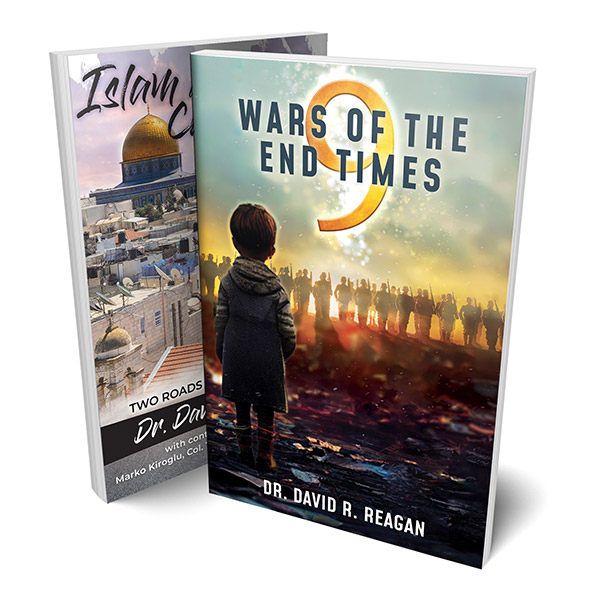
For those watching today, obviously, we’re talking to Kurt Jefferson, a tremendous friend of Lamb & Lion Ministries. But if you want to know more about Islam and the contrast with Christianity, we have our book, Islam and Christianity, both Nathan and I contributed. Along with Dr. Reagan’s 9 Wars of the End Times. If you call the number on the screen or visit our website, you can get both of them as a bundle deal and that will help you understand the dynamics that we’re witnessing right now. But there’s one more important question I think we need to drill down on. Nathan?
Nathan Jones: Yeah. In the minute we have left let’s get to how do we get the Gospel to the Iranian people? I hear there’s so many people dreaming of Jesus Christ. Are we seeing a great revolution in Israel, not militarily, but spiritually?
Tim Moore: And Iran, Israel and Iran.
Kurt Jefferson: Yes, I think you’re right, Nathan. I think that we need to continue to pray for the movement of the Holy Spirit to touch people and get the Gospel to Iranians and to Israelis. I really think several verses are key for me; John 3:3 and 3:5. We have to be bold about making sure people understand that conversation that Jesus had with the priest of Israel, Nicodemus. And Jesus talked with him and said, “Look, you have to understand you must be born again if you want to see and enter the kingdom of God.”
And I always find, guys, that a couple verses on, Jesus almost goads Nicodemus and says, “Listen, you’re a great scholar of Israel.” And Nicodemus isn’t thinking Jesus is a rabbi too. He’s a teacher and it’s important. But Jesus says, “How do you not know these things? You need to know that being born again is important.” And I would also say that secondly, John 5:22 is important. Jesus says, “The Father’s given me all judgment for the people of the earth.”
Tim Moore: Amen, well, Kurt, I’m glad you know more than Nicodemus did at that point. Of course, we have the blessing of hindsight and the indwelling presence of Holy Spirit. So I want to thank you for joining us today. And I want to let our viewers know, as I teased earlier, that you and I are collaborating on a book titled, Israel Against the World. And not a day goes by that I don’t see evidence that antisemitism is rising and that soon Israel will stand alone in the community of nations.
Kurt Jefferson: Thank you, Tim. Thank you, Nathan. It’s always great being with you both.
Closing
Tim Moore: Well, there you have it. Today’s headlines could’ve been written thousands of years ago. Actually, in a very real sense, they were.
Nathan Jones: For those who are ignorant of Bible prophecy, the news can be quite alarming. But sadly, even some Christians either grow despondent over what is happening in the world or they choose to cover their ears and close their eyes. But for those who have studied God’s Word, the prophetic pieces are falling in place. We can be assured that Jesus is coming soon.
Tim Moore: And here at Lamb & Lion Ministries, we stand with Israel. We also pray for peace and salvation for the Iranian people. It is our sincere wish that they would be delivered from the government and ideology that has oppressed them for so long.
The Prince of Peace, Yeshua Hamashiach, is coming soon to judge every person and every nation. We look forward to His glorious reign and pray that you are counted in His elect! Until He comes… Godspeed!
End of Program
