

Why should Christians influence public policy by voting? Find out with guest Andy Woods and evangelists Tim Moore and Nathan Jones on the television program, Christ in Prophecy!
Air Date: October 24, 2026
Video Links
Andy Woods Ministries
Sugar Land Bible Church
Pre-Trib Research Center
Chafer Theological Seminary
Resource
To order, call 1-972-736-3567, or select the resource below to order online.
Transcript
Tim Moore: Welcome to today’s episode of Christ in Prophecy. You know, every week we bring you a dialogue about a topic that is timely and pertinent to Bible Prophecy. That often involves an analysis of the Signs of the Times and the imminence of Jesus’ call for the Church to “Come Up Here” at the Rapture.
Nathan Jones: But today, we’re going to address the opportunity and responsibility followers of Christ have to serve here and now as we await our glorious home going. I’m speaking of the upcoming election here in America.
Some Christians are convinced that we should not sully ourselves by engaging in the political process. Others become consumed with trying to create heaven on earth, trusting in that same political process to legislate our way back to the Garden of Eden. Clearly, both extremes are fraught with peril.
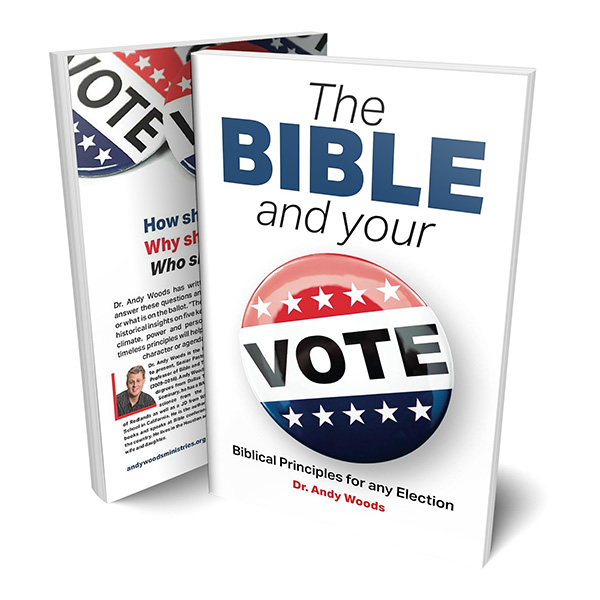
Tim Moore: Our guest for this important conversation is Pastor Andy Woods of the Sugar Land Bible Church, just southwest of Houston, Texas. Dr. Woods is an avid proponent of the Pre-Tribulation Rapture who serves as the Chairman of the Board of the Pre-Trib Research Center. He also serves as the president of the Chafer Theological Seminary. I’ve invited him to Christ in Prophecy to discuss his book, The Bible and Your Vote. So, Dr. Woods, Andy, welcome to Christ in Prophecy!
Part 2: Interview with Dr. Andy Woods
Andy Woods: Hey guys, great to be here, thanks! And thanks for taking on this topic.
Tim Moore: Well, it’s a very important topic, and as we said, it’s very timely given that the election is just around the corner. And frankly, I could have continued your biographical introduction by pointing out that you studied political science in college and then obtained your first doctorate in law. And clearly with that kind of background, you might have been on track to pursue a career in or around politics.
Andy Woods: Well, it’s interesting you bring that up. I’ve always loved politics. My father was an appointee to the California Judiciary by–this was back in the days when we had Republican governors in California, a guy named George Deukmejian, you might know that name. And so, I’ve always, just knee-high to a grasshopper, been around elections, politics, understood its meaning from a very early age, so I’ve always had an avid interest in it.
Tim Moore: Well, as tall as you are, Andy, and our viewers can’t necessarily see that, knee-high to a grasshopper was a very long time ago for you, my friend. I can say that given my own background in politics, after 13 years in the Kentucky legislature, I can tell folks that I am a recovered or at least a recovering politician, but even my kids used to tell them that I was a statesman, not a politician. And so, I appreciate your insights.
And the dedication of your book refers to your own abiding passion for the original version of the United States of America. We share that passion, a mixture of idealism, optimism, and hope that is now being assaulted by a reality that seems to be straying far from our Judeo-Christian foundations.
Andy Woods: Yeah, that’s something that, as I think Ronald Reagan said, doesn’t pass in the bloodstream, it has to be taught. And I was fortunate enough to be raised in a really patriotic family. I have a grandfather who was a Naval Academy grad, an uncle Naval Academy grad, another uncle, Air Force Academy grad. I already gave you a little background on my own biological father.
And so, you know, we would put the flag out on those special days, make sure the flag is in, before the sun goes down. And so, I was just very fortunate to be reared in that kind of environment. And so, I think that’s where I picked up this passion for the original vision of America.
Nathan Jones: Okay, well, in our introduction, we mentioned some Christians who reject the idea of gauging in the political process. We actually have a mutual friend who actually advises people not to vote. And so, to put a bottom line upfront, why do you reject such Christian isolationism?
Andy Woods: Well, probably the main reason is we have an opportunity to do something in this country that very few people in world history and even around the world today have ever had. And that’s the ability to influence public policy with our own voting. And so, since I have that privilege, why in the world would I not take my biblical understanding and bring it into that arena?
So, to become an isolationist, the way you’re describing it, just to me falls far short of the biblical mandate that we’re all given as Christians to be salt and light of the earth.
Tim Moore: Amen. Yeah, I find that so many who think, well, politics is a realm that’s beneath a Christian. I think, well, what realm is not appropriate for us to engage in? Every arena is where we should be, as you said, salt and light.
And I’m often reminded that Paul took advantage of his Roman citizenship, his ability to travel the world, at least around the Mediterranean Basin there in his day, and to have certain protections, again, based on being a Roman citizen. As he said, not even someone who bought their citizenship, but was born a Roman. So, from a biblical perspective, you talk about this stewardship, there’s responsibility. How do you see that playing in the political arena?
Andy Woods: Well, a steward is not an owner, but a manager. It’s someone who manages something on behalf of somebody else. And Christians all understand that we’re stewards of some things that God gives us. And there’s at least three, all beginning with the letter T. There is time, treasure, and talent. And I just want to add one other thing to the Christian stewardship list, particularly here in North America, and that’s stewardship of our own government. And I’m reminded of what Benjamin Franklin said leaving the Constitutional Convention when he was asked that question, you know, “What have you given us, doctor, a monarchy or republic?” And he turned it right back on the questioner. He said, “A republic, if you,” meaning the people, “can keep it.”
And so, since that’s the foundation of our country, I have to add our participation in public life as part of our stewardship. And as a steward who doesn’t own but manages, we have to give an account one day. And so that’s how I see stewardship entering into the whole picture.
Nathan Jones: I think people forget that in the Bible, God gave us governments to take His laws and take that over the people so there’s some moral constraints over the people. I mean, we see Jesus and Peter and Paul. I mean, what was their attitude towards authority even 2,000 years ago? I mean, they obviously were not elected as public servants, but the Lord and His apostles still recognized the God-ordained role that government had in the affairs of men, right?
Andy Woods: Right, well, they were living in a different form of government. And let’s go back to Genesis 9 and ask ourselves who invented government. I mean, who created the whole thing? Was it just, I think John Locke said it was a bunch of people kind of sitting around in a state of nature, you know, trying to figure out how we can best be protected and they kind of pooled their resources. That’s the secular account of it.
But the Bible, it’s very clear, Genesis chapter 9, government is an institution that God Himself raised up and He did it to restrain evil, to protect the kind of wild west violence mentality that, you know, engulfed the world pre-Flood. And man’s nature didn’t change after the Flood. And so, God put a restraint on human nature called government, which is to punish people for wrongdoings.
And so, when you get into the whole subject of the Christian and government, you know, we have to understand who created it in the first place. It was God. And if God created it, what are we supposed to do as Christians to be a steward of it and maintain it?
You go back to biblical times; they didn’t have a Republican form of government. It was a monarchy or some kind of, you know, centralized government in the form of Rome, let’s say. And so, the Christian, Romans 13, 1 Peter 2:13-17 is called to respect government, to submit to government, and to pay their taxes. And submission is not total submission. If the government traverses a law of God, then the Christian is to obey God rather than man.
But that’s what Christians have always been tasked to do regarding government. It’s just in our age, we’re living in a Republican form of government, which has some democratic principles worked into it and we can influence it through voting. And so, I think the apostles, if they were alive today, would be telling us to take our biblical principles into that privilege that we have today.
Tim Moore: Amen. You mentioned the responsibility we have, and I dare say it doesn’t begin with government. Every mom and dad knows that our spiritual responsibilities begin first and foremost at home, but then God has ordained other arenas, both government and the Church, where that family unit is to be plugged in and to be impactful.
And so, it’s interesting to me that in our own day and age, what is Satan trying to tear down? He’s trying to tear down that family. And of course, you have even people like the democratic socialists who are gaining sway in this country who, in opposition to what you say about the government constraining evil, they want to turn loose every prisoner regardless of the crime and have no more constraint on the excesses of mankind.
And so, it is a completely different worldview, but according to Scripture, we, first and foremost, must govern our own home. In other words, lead and steward that responsibility and then have sway beyond that, yes, in the Church, but also in government as we have opportunity.
Andy Woods: Right, I mean, by my count, there’s probably about five institutions that God Himself created, and you can find all of these in early Genesis. And this is long before the Church of Jesus Christ, Acts chapter two came into existence.
But those institutions are, number one, the institution of labor working, you know, working. Number two, you have the institution of the family that you’re speaking of. Number three, you have the institution of government. A fourth one that comes to mind is the institution of the nation state, that God, Tower Babel, doesn’t want humanity governed according to global government, but individual nation state governments.
And so, the fact of the matter is if God created those things, and any reading of Genesis 1-11 shows us that, the question becomes how do we function in those arenas that God created? I mean, we have to look at His rule book. So, I look at participation in those institutions as just as sacred and just as holy as membership in one’s local church, because these are all things that come from the hand of the creator.
Nathan Jones: Well, Dr. Woods, how does Abraham Kuyper’s admonition fit into this conversation? He said, “There’s not a square inch in the whole domain of our human existence over which Christ, who is Sovereign over all, does not cry, Mine!” Now he was a 19th century Dutch theologian and former prime minister.
Andy Woods: Well, the Bible is inspired, which we all believe. It’s inspired by God and it will touch on subjects like John 3:16, a verse we all memorize very early as Christians, how to get to Heaven. And the Bible also not just touches on John 3:16, but it touches on the realm of economics. It touches on the realm of government. And it’s just as inspired in those latter realms as it is when it talks about John 3:16.
So, one of the things that’s happened to Christians is we want to focus on John 3:16, rightfully so, not understanding that God has given us 66 books and the Bible is equally as inspired when it deals with those other subjects. So, to the statement, you know, that you’re speaking of, I just say amen. You know, let’s embrace the Full Counsel of God’s Word.
Tim Moore: Amen is right. Well, you opened the first chapter of your book, Stewardship and Practice, and I love that concept in itself, but you’re citing 1 Corinthians 4:2. “In this case, moreover, it is required of stewards that one be found trustworthy.”
And so, if we argue, and you already have, that America was founded as a republic, but even more than that on Judeo-Christian principles and adhered overwhelmingly, if imperfectly, to Christian principles, how have we drifted so far? How have we, as Christians in America, failed to be trustworthy, good stewards of what was handed down to us?
Andy Woods: Well, one of the things we’ve done is we have moved into what I would call bifurcation, where certain parts of the Bible are very important to us. As I mentioned before, John 3:16, just as an example.
But shouldn’t economics be important to us if the Bible deals with that subject? Shouldn’t human nature be important to us if the Bible deals with that issue? Shouldn’t the realm of government be important to us if the Bible deals with that? So, we have to sort of rescue the Christian mind from the kaleidoscope that it’s in where it will focus on certain topics, but for whatever reason, builds a fence or a wall where we can’t deal with other topics.
You’re no doubt familiar with the late Francis Schaeffer, and he talked about these issues constantly. And I would just say we need to bring back more of his philosophy, you know, into modern day Christianity.
Nathan Jones: Absolutely. Well, here you’re from California, and so we’re so glad that you came to Texas as fast as you could. Al Mohler over at Southern Baptist Theological Seminary, he likes to say that the closer you get to the coast, a city, or a college, the more leftward the political tides are pushing. How does the left coast offer a cautionary tale to the rest of our country? Can California and other liberal leftist enclaves actually be saved?
Andy Woods: Well, that’s a very good question, interesting one, that you brought up because I’m a California native. And as I like to say, I got to the promised land as fast as I could when I moved to Texas around age 30 to pursue education. But, you know, it’s an interesting thing. California was not always what we know today. I remember it as a very strong red state.
In fact, here’s an interesting point. George Herbert Walker Bush in the 1988 presidential election carried California, and we get names like Richard Nixon coming from California. We get names like Ronald Reagan, very conservative presidents coming from California. And so, the issue is what happened to California?
Well, they flipped California and they largely did it through illegal immigration. And so, when people tell me Texas can’t flip or some other red state can’t flip, I say nonsense. I watched it happen in my home state.
And to quote our own president, Donald Trump, he says, you know, “The left is really not good at a lot of things.” But I’ll tell you one thing they’re good at. They’re good at, dare I say, cheating, and they’re very good at, once they get in power, to sort of organize the structures of society where no one else can get into power. And so, what has happened in California is a blueprint for what will happen to the rest of the country, state by state, if our people don’t wake up fast enough.
Tim Moore: Yeah. I mentioned the Democratic Socialist earlier. They have already let loose their blueprint for America, which includes getting rid of the Senate, which is a check on the sometimes-rash power of the House. They want to get rid of the presidency. They want to stack or get rid of the Supreme Court. Why? Because that will seal their power as far left as forever.
But let’s get to another bottom line. Nathan mentioned that earlier. How can a Christian watching today who wants to impact this country or their state or city or school board, and folks, believe it or not, your school board has much more power and can do much more damage than most people realize, how can a Christian impact all of those various institutions for Christ, and how do we choose when selecting between arguably imperfect candidates?
In other words, unless Jesus Christ is on the ballot, every other mere man is imperfect. So, Dr. Woods, what issues should a Christian consider? Should it be the economy, social issues, climate, power, and personal rights, foreign policy? How do you rack and stack and choose between imperfect candidates?
Andy Woods: Well, the first thing to do is to pray. I mean, that’s what we’re told to do in 1 Timothy 2:1-4. The second thing to do is to get up to speed, because a lot of times we just choose to ignore what’s happening related to public policy. You can’t have much of an impact if you don’t know exactly what’s going on. The third thing to do is to maybe run for office ourselves. And I’m not talking about just waking up one day and wanting to become President of the United States. I’m talking about local elections, school board, city council. I think Tip O’Neill said, you know, “All politics is local.”
And then one of the things to understand is when we vote, which is also something we should regularly do, is to understand that Jesus is not on the ballot, okay? Jesus is going to come back one day, we all believe that, and govern this world in perfect millennial fashion for a thousand years, but we’re not there yet in terms of the prophetic chronology.
So, until that time comes, you’re not going to find a perfect candidate. You have to choose between imperfect people. And that shouldn’t be front page news because we have to make choices like that constantly, right down to what kind of car I’m going to buy, what kind of neighborhood I’m going to live in, what kind of career I’m going to pursue. There’s no perfect choice. You always are picking the lesser of two evils. And so, I’m going to suggest that you use that same mindset, that same decision-making process in the electoral process as well.
And then when you make a choice, there’s some basic fundamentals in the Bible to look at. You mentioned social issues. The first on the list is the right to life because the Bible supports the personhood of the unborn. Another issue is economics. Karl Marx in his communist manifesto denies private property, I think in his very first of 10 points. Well, the Bible affirms private property. It’s built into the commandments, “Thou shalt not steal and thou shalt not covet.”
And then you look at the climate issue, we should all be concerned about the climate, but I’m wondering, does the candidate want to invest himself or herself in Earth worship or Earth stewardship? The latter obviously being far more biblical.
And then you kind of work your way down the list and you come to constraints on the government itself. Does the candidate believe that there are limitations on government? The Bible thinks there are because it says things like we, at the apostles speaking, must serve God rather than man.
And then you look at foreign affairs. Right on the list is Israel, which is a hot topic today. A lot of people want to dump our relationship with Israel in the Middle East. I say don’t do that because God makes a foreign policy statement in Genesis 12:3 concerning Israel, “I’ll bless those who bless you, curse those who curse you.” I want to be on the blessing side of the ledger. So that would be a foreign affairs issue I would be looking at.
And my book goes into a lot more detail developing these different issues, but that’s kind of a basic rubric, you know, that your average Christian can follow when selecting between imperfect people.
Tim Moore: Yeah. I actually hope that our viewers will get a copy of your book. You’re going to find the telephone number or our website on the screen, and we would be glad to send you a copy of Dr. Wood’s book, The Bible and Your Vote. It’s very timely, especially in a season such as this, but really, it applies in any election.
And Andy, I always remind people, it’s one thing to be in America, a traditionally Judeo-Christian country. I dare say we’re not reflecting that today, but I ask people, what if you were a Christian in India, which ostensibly has elections and you had to choose between a radical Muslim and a Hindu candidate? Should a Christian just stay home?
The answer is no. The Christian should choose between those two imperfect candidates based on which one is going to respect Christian’s right to worship the true living God, which one is going to respect Christian’s rights in every other quarter. And so, you’re going to have to choose between the two imperfect, which one is best suited to promote the cause of Christ even in that non-Christian country.
Well, the key to overcoming the inevitable shortcomings of any man is to ensure checks and balances. I mentioned already that some on the left want to get rid of those checks and balances in this day and age so that they can obtain and then maintain absolute power. But we know that absolute power corrupts absolutely.
Andy Woods: Well, the genius of the American Constitution, because there’s a lot of voices today saying it’s old, let’s chuck it and let’s get something more up to date. But the genius of the American Constitution is it’s a restraint on human nature and it prevents one person like Nimrod at the Tower Babel, for example, from getting control of everything. And the only person that’s capable of getting control of everything would be Jesus, and we can trust Him with that power because He doesn’t have a sin nature.
Every other person that finds themself in that position will abuse that power and move us into tyranny. That’s where that statement you just gave Edmund Burke, I think it is, power corrupts, absolute power corrupts absolutely. So, the genius of the American Constitution is it prevents that from happening by dividing power.
And so, when you hear these voices today saying the Constitution is outdated, the proper response is it’s not outdated because it’s a shackle on human nature and human nature never changes. This is why we all need the savior, Jesus Christ.
And so, let’s be wary of people that want to, you know, throw out the Senate, pack the Supreme Court, move to DC statehood, I think it is, and all of these structural changes. You’re throwing out something that’s worked really well since our constitution was given to us in 1787 roughly as a restraint on human nature, and that needs to be there because human nature never changes.
Nathan Jones: Well, Dr. Woods, how do you explain the shocking rise, we’re seeing socialists, they call them democratic socialists, but we know they’re communists, are rising all across the country? We’re seeing Muslims teaming up with these democratic socialists, and especially here in Dallas area and your area in Houston, we’re seeing a great rise of Islamic being accepted even to the point where people are advocating Sharia law being allowed to coexist. Where is this coming from?
Andy Woods: Well, they have to tear down the United States because as long as the United States currently exists, you have a functioning example of a politically and economically prosperous country that’s not Marxist or Islamic. And so, when they’re running around saying the free market doesn’t work, Christian principles in public life don’t work, the counter argument is look at America.
Well, for them to take that argument away, they have to destroy America. And so that’s why for a long time now, there’s been a lot of infiltration into the centers and levers of influence and power, particularly in the areas where people develop values like the pulpit, media, education, to tear down our country. I mean, they have to do it because as long as America is up and running the way it is, it’s a refutation of all the arguments the Marxists can offer.
Tim Moore: I think there are other refutations out there. You can look at places like Venezuela, that was one of the most prosperous countries in South America until they embraced socialism and then it became just an armpit of South America. It fails every place it’s actually been tried.
But to return to, I guess, the theme that we’re striking today of the importance of impacting the world here at home through your vote, I just think of the passage I’ve been open to this entire conversation, and that’s Jeremiah 29. Even as Jeremiah, this prophet of doom, the weeping prophet was writing to the exiles in a pagan country of Babylon, he was encouraging them.
And in verse seven, he told him to seek the welfare of the city, the Lord speaking now, “Seek the welfare of the city where I have sent you into exile and pray to the Lord on its behalf for in its welfare, you will have welfare.” We arguably are living as exiles in a pagan world, increasingly pagan country, but we should seek its welfare through every means possible, and that includes through our vote, our advocacy, and even our public service.
Andy Woods: Yeah, I’m so glad you brought that up. That’s such a great chapter and it’s such a great verse because Jeremiah, they weren’t in their homeland, they were in exile, as you pointed out, and yet in exile, they had responsibilities.
Well, we can develop an analogy the same way. We’re not home yet. The Rapture hasn’t happened yet. We’re still here. And while we’re here, we have basic responsibilities that we’re supposed to pursue, stewardship in those three areas that I talked about a little earlier, and also in the realm of government, particularly here in North America.
And, you know, as prophecy people, we spend a lot of time talking about 2 Thessalonians 2, which is great, but what about chapter three? We kind of forget about chapter three. In chapter three, the Thessalonians were using the excuse of the Rapture to get out of life’s responsibilities. And so, they were hearing voices saying, “Hey, the tribulation period has started, and what’s the point of holding down a job if Jesus is coming back?”
And look at Paul who taught the pre-Trib Rapture, look at him aggressively deal with that lack of stewardship in the third chapter. So, to our prophecy studies, I want to emphasize chapter two, but I also want people to understand that chapter three comes after chapter two, and we shouldn’t use prophecy as an excuse to get out of life’s responsibilities.
Nathan Jones: Absolutely. Well, Dr. Woods, I so appreciate your insights, your leadership in this arena, and in the Christian arena as well. How can our viewers connect with your ministry and follow the Pre-Trib Research Center?
Andy Woods: Well, the Pre-Trib Research Center was, as you know, started by the late Dr. Tim LaHaye and Thomas Ice to get back to an academic defense of the Pre-Trib Rapture, and that website is www.pre-trib.org. And then if people want to follow me personally, the easiest way to do it is just andywoodsministries.org and it’ll give you all the different outlets, you know, where I’m involved in a ministerial sense.
Tim Moore: Well, Andy, thanks again for joining us today on Christ in Prophecy. I hope our viewers will get a copy of your book, The Bible and Your Vote, just by calling a number on the screen or visiting our online store at christinprophecy.org. And I know we’ll be praying for God’s will to be done this November, even as we are absolutely confident that it is His will that will always be done.
Andy Woods: Amen, I want to thank you guys for having me on, and I want to thank you all for doing what you do, because what you’re doing is a vital ministry, and so I’m glad that we could be co-laborers together in this.
Closing
Tim Moore: Well, there you have it, folks. Soon the Lord will call the Church home, then following the rise of a global dictator who will promise universal equality, but wield unprecedented power to enslave mankind, Jesus will return to reign.
Nathan Jones: I am looking forward to that benevolent dictatorship. No more legislatures. No more Supreme Courts. No more presidents or prime ministers. Just the Lord strong and mighty ruling from the throne of David with a rod of iron. Until then, we live and serve in every corner of human existence. We seek the welfare of the societies in which we live.
Tim Moore: And as ambassadors of a soon-coming King, we promote the cause of Christ as far as the curse is found.
So, brother and sister in Christ, study the issues, weigh the candidates, and vote this November. Then stay engaged and hold your elected officials accountable. Volunteer and serve wherever the Lord has planted you.
Until next week, on behalf of all of us here at Lamb & Lion Ministries, Godspeed!!
End of Program
