

Can the Messiah be found anywhere in the book of Psalms? Find out with Dr. David Reagan and evangelists Tim Moore and Nathan Jones on the television program, Christ in Prophecy!
Air Date: June 6, 2026
Video Links
Praying the Bible (Book)
Prophet, Priest, & King: The Three Offices of Christ (Book)
Resource
To order, call 1-972-736-3567, or select the resource below to order online.
Transcript
Tim Moore: Greetings and welcome to Christ in Prophecy. We have much to celebrate at Lamb & Lion Ministries, including the privilege of crying in the wilderness that the Messiah is coming soon, and a constant reminder of God’s goodness and provision as we serve Him faithfully.
Nathan Jones: As we record this episode, Lamb & Lion Ministries has just recently celebrated its 46th Anniversary. Formed in 1980 when the United States was ensnared in yet another Iranian crisis, Lamb & Lion has been faithful through all these years to proclaim the soon return of Jesus Christ, and we even emphasized the Signs of the Times from a biblical and prophetic point of view.
Tim Moore: The man who God called to launch this ministry was Dr. David Reagan. And Nathan and I had hoped to have Dr. Reagan back with us today, but sickness and circumstances delayed and then altered his personal participation in this episode. We pray that he will be able to join us again soon but want to share a tremendous new resource with you.
Nathan Jones: Dr. Reagan is a prolific and widely respected writer. We featured many of his books on Christ in Prophecy, and you can visit our website at christinprophecy.org to find all of his books that we carry.
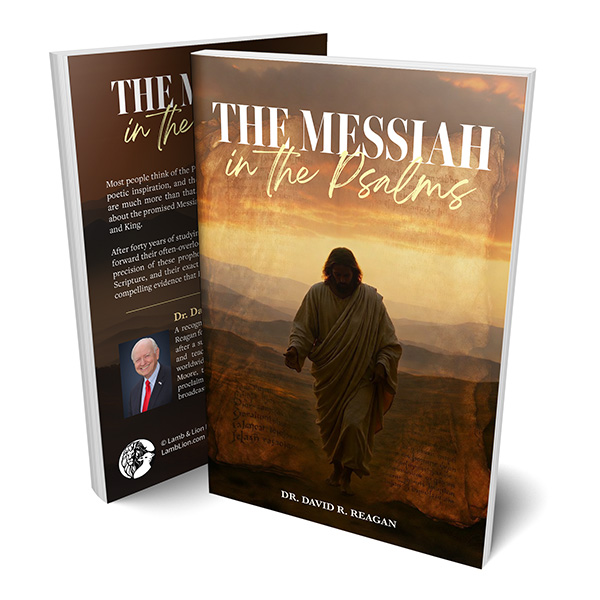
Tim Moore: Lamb & Lion Ministries recently published Dr. Reagan’s newest book, The Messiah in the Psalms. This book reads like a primer on one of our favorite books of the Bible, and one that contains more prophetic revelations than most Christians realize: Psalms.
Before we look into this latest book, listen to how Dr. Reagan describes the Book of Psalms.
Clip 1: Dr. Reagan describing the book of Psalms
David Reagan: Now, the first thing that I want you to note about this Psalm is that it was written by David Ben-Jesse. There is no superscription in this Psalm. If you look in your Bible, no superscription, although there are for Psalms 3, 4, and 5, all are identified as Psalms of David. But this one has no superscription, no identity of the author.
But we know for certain that David wrote it because in Acts 4, Paul, I mean Luke, through the power of the Holy Spirit said, “The Holy Spirit spoke through the mouth of our father, David, your servant, saying,” and then he begins to quote Psalm 2.
Now, the language of these verses is rather stilted in English, so let me try to put the words in modern English for you. Start with verse one. The psalmist is asking, “Lord, why is it that everywhere I look in the world, I see nations in turmoil? Why are they always devising some vain thing to the glory of man like the Tower of Babylon, the Roman Empire, the League of Nations, the United Nations?
Why is it, Lord, that the presidents, the prime ministers, the kings of the earth, are always conspiring against you and against your anointed one, Jesus? Why is it that the world’s political leaders are always shaking their fists at you and saying the words of verse three, let’s put aside the limitations of God’s Word and let’s cast away His laws and let us do what we please.” Well, as you can see, nothing has changed in 3000 years.
Nathan Jones: Well, clearly there’s much more to Psalms than merely a collection of hymns, although it would merit our appreciation and study just for the worship it conveys. But the life of David, along with the many of the Psalms that he wrote, contain tremendous gems of prophetic significance. As we discussed a few years ago on Christ in Prophecy.
Clip 2: Dr. Ragan Speaking on the Prophetic Significance of the Psalms
David Reagan: We have discussed three types of Bible prophecy, written, spoken, and acted, and we’ve looked at a lot of differences within those. Now there’s a fourth category, and it’s my favorite. I’m speaking of symbolic prophecy.
Nathan Jones: Well, Dave, since you said this is your favorite form, how about introducing it?
David Reagan: Okay, well folks, I’d be delighted to introduce this. One of the reasons I love this form of prophecy so much is because it will help you find Jesus throughout the Old Testament, almost every page. And what I have in mind is that people, events and even inanimate objects can be a symbol of the Messiah and events in His life. Tim, let’s begin with you. Give us an example.
Tim Moore: Okay, I’ll give you two examples actually, Dave, I can think of David who was a shepherd boy, rejected, if you will, to be the foremost in people’s minds as a person going many places. Jesus Himself was rejected, and yet David was anointed. The other symbolic nature of David’s reign is that he was anointed king, but he had to wait a long time before he was coronated…
David Reagan: King in waiting…
Tim Moore: A king in waiting. And Jesus…
David Reagan: We’ve got a king in waiting right now.
Tim Moore: We have a king in waiting. He is reigning in Heaven, but He has not yet exerted His authority and reign here on Earth. And so He is anointed but not yet coronated, so to speak, here on Earth.
Back in Studio
Tim Moore: Well, obviously we’ve released a number of resources this year, including our Prophecy Chart and my own High Fight devotional. But the Book of Psalms has always been a go-to resource for us at Lamb & Lion Ministries, both for Christ in Prophecy and for frequent Lamplighter additions and articles.
Nathan Jones: And obviously when most people think of the Psalms, they think of the Davidic hymns of praise or poetic inspiration and heartfelt cries of contrition and longing. Sometimes they think of the Imprecatory psalms that call for God to judge the enemies of Israel. But Dr. Reagan has long asserted that the Psalms are filled with prophetic references to the Messiah as well as references to His glorious Second Coming in the End Times.
Tim Moore: And really, I think that’s where we want to jump off, Nathan. I think most Christians think that they are familiar with the Book of Psalms because they’ve read individual psalms. They may even have read the whole book or they have favorite psalms that they’ll cite. We’re going to get to Psalm 23 in a moment, but after studying the book as a whole, Dr. Reagan recognized some of the overarching themes and some of the beautiful details that are tremendously prophetic and messianic in their detail.
Nathan Jones: Yeah, I think what throws off a lot of Christians is the way the Book of Psalms is written, broken up into five different divisions or books, but there’s no logic to them. And also that the Psalms were written from King David all the way to the Babylonian exile, most people assume that, well, David was the only writer, but we have Solomon, we have unknown prophets, we have worship leaders.
And it’s amazing too that, all of the Bible in the Psalms point to one particular verse, and that’s Psalm 118 verse, actually two, 8 and 9, and it’s the focus point of the entire Psalms. You want the theme of Psalms, it’s “take refuge in Yahweh,” which is a beautiful thing. All of the Psalms.
Do you remember watching that old “Monty Python and the Holy Grail?” And they had this scene where God supposedly comes out of Heaven and he’s complaining about how boring the Psalms are and how depressing and all, and that always stuck in my head because when you actually read the Psalms, they’re anything but.
Tim Moore: Yeah, they’re anything but. As a matter of fact, they are rich fields of encouragement for those who want to worship the Lord.
As a matter of fact, there’s a way in which you can read through the Psalms. I’ve even had an advocate by the name of Don Whitney who wrote a book called Praying the Bible, and he specifically says, “Every day pick a psalm on the first day of the month, pick Psalm 1 or Psalm 31, 61, you get the idea, and pray that back to the Lord.” I guarantee it, as you pick one of the Psalms that end in the number one on the first day of the month, one of those, the Holy Spirit will resonate in your heart and it will be an opportunity to praise the Lord, to worship the Lord with the words that were inspired by the Holy Spirit. And you’re right, even Moses has a psalm recorded there in the book.
Well, I think Dr. Reagan did a tremendous job of giving us really a primer on why this book is so important and instructive. He points out, just in the opening chapter, that when we read the New Testament, some people might fail to realize that Mary, as she sang her song of rejoicing, was citing eight different times, the Psalms.
When Zacharia sang a song to celebrate the birth of John the Baptist, he was using five different psalms woven into his song. When Peter preached his first sermon there at Pentecost, it was chock full with prophetic fulfillment from the Psalms. And Paul did the same thing in his first sermon at Antioch. He had a number of Psalms woven into his message.
Over and over again, we see this, even the multitudes, Nathan, that gathered on Palm Sunday to celebrate Jesus coming into Jerusalem, Hosanna to the Son of David were citing Psalm 118, the one you just mentioned in verse 26. “Blessed is the king who comes in the name of the Lord.”
Over and over again, we could talk about how the Psalms are all over the New Testament because they are being fulfilled in the life and ministry of Jesus. And even in the outpouring of the Holy Spirit.
Nathan Jones: Even crazy enough, Satan resorted to quoting the Psalms when he was tempting Jesus. He went to Psalm 91 to try to tempt Jesus. So it’s interesting that even Satan is reading the Psalms.
Tim Moore: He certainly is, yeah. I think Satan knows Bible Prophecy and Scripture sometimes better than us, and so we have to be grounded in the Word less he would trick or deceive us.
Well, Nathan, we’ve talked many times and Dr. Reagan highlights the fact that there are a number of types of Psalms. So in his book, The Messiah in the Psalms, he kind of lays a groundwork that these types offer us sort of a panorama of life itself. What are some of the types of psalms that we find?
Nathan Jones: Well, Dr. Reagan puts them in 10 different categories, and the first ones are what most people think of the Psalms, Psalms of lament. They’re pleas to God for help. You can find that in Psalm 28 and 44 as examples, and you hear that as frequently through David who was a type of Christ. Many of the times that you listen to David, you hear that David is basically echoing ahead into the future where Jesus will quote the words of David, the same laments. Situations that David was in, where his enemies are surrounding him and things like that are prayers that Jesus made based on that.
So you can find lament. You could also find, of course, wisdom. We kind of think of Proverbs, but in Psalm 1 and 119 is a very good guide for how to live a holy life.
Tim Moore: Yeah, it certainly is. Well, all of these different Psalms point to the person of Jesus Christ. And so what would you say are some of the Psalms that highlight the prophetic nature and really the messianic anticipation of Christ with His First Coming or that we are still looking forward to fulfillment in His Second Coming?
Nathan Jones: Oh, absolutely. Well, there are 16 that are distinctly messianic in origin here. And so you can go to say Psalm 2 for instance, which seven times was quoted in the New Testament, “You are my son, today I have begotten you,” which is about the incarnation. Or “I will surely give the nations as your inheritance, the reign of Jesus.” These aren’t prophecies about Israel; these are prophecies about the Messiah. Very clear, very distinct. 16 of them.
There’s also 17 that allude to the Messiah and for easy reference that makes 33, right? Jesus died at 33 years old, there are 33 at least. But on top of that there’s 17 more that point to situations concerning the Messiah’s future reign or glorification and all that. So you’ve got the 33 plus the 17, so basically 50 different Psalms that are specifically about Jesus Christ. We can learn about Jesus’ future, written, get this, 1000 years before Christ came.
Tim Moore: Yeah, that’s what’s amazing is prophetic in nature. But we can look back now through the blessing of hindsight and see that they were fulfilled, at least some of them already. We know others await fulfillment.
So the Psalms pointing to the temptation of Christ, Psalm 91, the triumphal entry, I’ve already cited from Psalm 8, Psalm 118, the Gethsemane agony in Psalm 69, the betrayal in Psalm 41, the crucifixion, the resurrection, they’re all there, even the ascension and anticipating the Church being born at Pentecost. But then you have a whole series of psalms that point to the Second Coming.
So whether it’s the Rapture and the Marriage Feast of the Church there in Psalm 45, the return of the King of Glory in Psalm 24. Over and over again, we are given previews and we know if God fulfilled the first coming Psalms with great precision and literal fulfillment, we know He’s going to fulfill all those second coming Psalms.
Nathan Jones: Yeah. I mean we’ve got to go back to the fact that the Bible was inspired by the Holy Spirit. And the Holy Spirit, the Son and the Father are three and one. So if you really want to get an in-depth understanding of what Jesus thought and felt, you go to these messianic Psalms here and we read a lot about His teachings and the Gospels certainly, and we read about His triumphal return in Revelation, which is in fulfillment of these. But if you want to know the heart of Jesus Christ, you go to the Psalms.
Tim Moore: Yeah. You know what? I think that’s a great point because some of the other books of the Bible are narrative in their style and they convey information of God revealing Himself.
So whether it’s Exodus, Deuteronomy, I’ve even said, I love the book of Leviticus and my pastor says, “Only Tim Moore loves the book of Leviticus.” But I do because it reveals God’s character of being so holy that no one can approach Him. And yet so loving that He comes down to interact with us, His creatures. And so He came down in the person of Jesus Christ. You can see that in Leviticus.
But nevertheless, Psalms in their worshipful poetry and the music that they inspire still today, I think you’re exactly right. They reflect the heart of Jesus, and over and over again, He cited of the Psalms Himself.
Nathan Jones: Oh yeah, yeah. Very much so. And you learn so much about the life of Jesus too. For instance, Psalm 8, if you want to know about the incarnation, you made Him, the Son of Man, a little lower than the angels. Psalm 16, “You will not abandon my soul to Sheol.” That’s a prophecy about the resurrection. You get Psalm 40, “Be pleased oh Lord, to deliver me.” This is something pointing to the crucifixion.
So when you get certain pastors who say, “Well, we need to cut off the Old Testament because it’s not relevant to the New,” Jesus’ First and Second Comings are living examples of what He prophesied 1,000 years ahead of time. It’s like reading the New Testament.
Tim Moore: Well and making it relevant to today, the very first psalm that Dr. Reagan dives into, and we’ve talked about this before, I know he has as well, on Christ in Prophecy, but is Psalm 24 and the gate to prophecy. And all the way back in 1967 when the Israeli defense force, they’re back in the news today you might say, but when they were contemplating whether or not to recapture the old city, they were trying to decide which gate they might enter in.
And there was talk about blowing the Eastern gate, which has been sealed since the days of Suleiman the Magnificent. And it was an Orthodox Jew who said, “No, you cannot blow up the Eastern Gate. Only the Messiah can go through that.” And the secular Israeli Jewish fighters didn’t have any idea.
But even Dr. Reagan has told about how he learned of the prophecy related to that gate. And so Psalm 24 became a gate of prophecy for him. And I dare say we find it exciting still today.
Nathan Jones: Oh, I love this. So verse seven says, “Lift up your head, O gates, and be lifted up, O ancient doors, that the king of glory may come in! Who is this king of glory? Yahweh strong and mighty.” And it goes on to talk about this Messiah who’s entering.
When Suleiman the Magnificent heard about this passage, he didn’t want another Jewish Messiah coming in and taking over his city. And so like you said, he walled it up, he put a graveyard, Islamic graveyard, because no rabbi is going walk through an Islamic graveyard. He said, “Yeah, that’s going to keep out the Messiah.”
But then we read here in Psalm 25, excuse me, 24, about how when the Lord comes back and He lands on the Mount of Olives with such force, He’s going to make a new valley through the Kidron. And the Jewish people who are being besieged by the Antichrist will escape through. Then He’s going to blast open that gate, He’s going to go up to the Temple Mount.
I think that third Temple, that desecrated Temple, will be destroyed and only Jesus Christ going forward. Because we learn about in the Millennial Kingdom, only Jesus will come in and out of that Eastern Gate.
Tim Moore: Yes, I get excited every time I stand on the Mount of Olives and look down on that Eastern Gate or walk through that cemetery and stand right before the gate. And I always think about this passage, repeated what you just read in verses 9 and 10 says, “Lift up your heads, O gates, and lift them up, O ancient doors, that the king of glory may come in! Who is the King of Glory? The Lord of Hosts, He is the King of Glory.” And we know that he has a name Jesus Christ Incarnate who will come through that gate.
Well, the next chapter touches on a psalm that we believe Jesus recited as He hung on the cross because we know He cited the first verse and the last verse. And so it’s quite possible as He was there, He was reading or reciting rather the whole Psalm 22, which focuses on our suffering Savior, something the Jews didn’t even understand when Jesus came the first time. But obviously David, through the impression of the Holy Spirit, did prophesy that suffering.
Nathan Jones: Yeah, we can read in the gospels about the crucifixion of Jesus. And it’s almost facts and figures. I mean, it does touch the heart a little bit. But if you read Psalm 22, you go through what Jesus is thinking on the cross, His agony, His suffering, not only that He’s being mocked and that it even implies that the demons were marching around Him. That the Sanhedrin and the elders of the people had rejected Him.
But the agony He’s felt spiritually as the weight of the world’s sin on a perfect holy being all of a sudden took on the sins of the world upon Himself, on top of all the physical agony on the cross.
But also when you get the joyous, when you know it begins, “My God, my God, why have you forsaken me?” But as it goes on, all of a sudden it shifts. Because you know that, okay, He’s finally died, He’s ready to go, and He ends, “It is finished,” which is the last thing He said on the cross. So you get a beautiful insight into the Suffering Servant there on the cross.
Tim Moore: Yeah, Lama Sabathani, why have you forsaken me? And Jesus cited that in Aramaic as He hung on the cross. But at the end of that particular Psalm, David says, “They will come and will declare his righteousness to a people who will be born.” In other words, this message will go forth beyond even that moment that He has performed it.
And so even this psalm, all the agony and it goes through the spiritual, physical, emotional suffering that Christ manifests there on the cross. The affirmation of tough faith, the prophetic anticipation of the resurrection and the recounting of blessings at the passion. But this idea that He has performed it, well at the end, Jesus said, “It is finished.”
Nathan Jones: It is finished.
Tim Moore: Again, an Aramaic version of He has performed it because indeed He did at the cross of Calvary.
Nathan Jones: You know what’s neat about this? It says again, verse 31, “To a people who will be born.” This is a prophecy. And it’s talking about the audience, a future audience. It’s talking about us.
Tim Moore: Me and you, yes.
Nathan Jones: We are right here in this…
Tim Moore: I get excited.
Nathan Jones: So the entire crucifixion, the Lord says, “Okay, I’m going to not tell just this generation, but generations ahead of all the Christians coming up. And so if you want to find yourself in the Bible there, that’s verse 31.
Tim Moore: And there’s many places where it refers to those who will believe, who have not seen this Jesus called Thomas. Well because of His suffering, folks, we then turn to the next Psalm, arguably perhaps one of the most frequently cited many times at funerals and other moments, people will call on Psalm 23, which points the Lord as our shepherd. But Dr. Reagan highlights, not only is He our shepherd because of His experience and being able to understand our suffering because of His own suffering; He is also our great and perfect High Priest.
Nathan Jones: Yeah, my version says Yahweh, but most people know it as, “The Lord is my shepherd, I shall not want.” And we call this sometimes the Lord’s prayer. “He makes me lie down in green pastures; He leads me beside quiet waters. He restores my soul; He guides me in the paths of righteousness,” what? “For His name’s sake.”
Tim, like me, and probably countless people throughout the last 2000 years…3000 actually, have found such comfort in this passage. Because when times are rough and the life seems chaotic and things are dark, I look forward to when the Lord promises the fulfillment of this in the Millennial Kingdom, when we’ll sit underneath our own fig tree and nothing will make us afraid. That’s what this is pointing to. When the Prince of Peace comes, we’ll know true peace.
Tim Moore: We certainly will. And even as it talks about, He leads me or guides me in the paths of righteousness for His name’s sake. As my guide Erez Bar David has said, “If you go to Israel, those paths are circular paths around the mountains going higher and higher.” The sheep don’t always know where they’re going. The Shepherd does, if we will follow Him, He is faithful to take us to high pastures, to solid food that will feed our souls. And so we just have to trust in Him.
Nathan Jones: Look at verse six just quickly. It says, “Surely goodness and loving kindness will pursue me all the days of my life, and I will dwell in the house of Yahweh forever.” That is a messianic psalm about Jesus Christ coming in, setting up His Kingdom and ushering in 1,000 years of peace.
Tim Moore: Yes, it certainly is. And what hindsight, we have a blessing. David anticipated his greater son who would follow. The Lord said to my Lord, as he said. But here we have David pointing to a person whose name he doesn’t know. And Nathan, you and I, our viewers, we have the blessing of knowing Him by name, Jesus Christ, our Messiah.
Well, that brings us to Psalm 2, the last…
Nathan Jones: It’s such a shame we have to rush through these, isn’t it? These are beautiful.
Tim Moore: Well, we’ve talked about this before and we will again. But this is a psalm pointing to our returning King and recognizing that the very nations will be in turmoil trying to cast off His fetters. And yet all of their efforts to throw off the Lord’s authority over them. God sits in Heaven and laughs.
Nathan Jones: You know, I know that for a fact this is one of Dr. Reagan’s favorite psalms. He gets a glint in his eye; he gets a chuckle every time he preaches on it. “Why do the nation’s rage and the people meditate on a vain thing? The kings of the earth take their stand and the rulers take counsel together against Yahweh and against his anointed saying, ‘Let us tear their fetters apart and cast away their cords from us!” And this is the kicker here in verse four. “He who sits in the heavens laughs.”
Tim Moore: Wow.
Nathan Jones: You know, we look around and everyone’s so worried about the rising beast system or the ineptness of human government. And folks, God is up there on His throne laughing at the machinations of human beings. Not because He, you know, He finds us funny. But because all our scheming and plotting and planning will eventually go to naught. It’s a fact that Jesus Christ will return and set up His kingdom. All their plans are going to come to… They’ll never come to fruition.
Tim Moore: They’ll never come to fruition. And the fact that He is our soon returning King, I’m reminded of Dr. Al Mohler’s book, A Prophet, Priest & King talking about the three offices that Jesus Christ fulfills. There was never a perfect high priest. There certainly wasn’t in Jesus’ day and age. There was never a prophet who was blameless in terms of righteous in their own person. And so Jesus is not only the prophet, He is that perfect high priest and He is the coming King who will reign. And I look forward to living in that monarchy.
Nathan Jones: Absolutely. Absolutely. I love the fact that Dr. Reagan ends the book with a summary of End Time prophecies in his last chapter, page 155. And he categorizes them like he always wonderfully does into easy ways. And I love how he points to the fact that the Rapture, I mean, that’s what our main mission is proclaiming the soon return of Jesus Christ. And he talks about the Psalms that point to the Rapture, particularly the ones shielding Christians from God’s wrath.
Like Psalm 2:12, “Kiss the Son, lest he become angry, and you perish in the way, for his wrath, may soon be kindled. How blessed are all who take refuge in him!” Psalm 5, Psalm 27, Psalm 45, again and again, it talks about the Lord protecting His children and taking them out before His wrath is poured out.
Tim Moore: Certainly, and yet there are other Psalms talking about the anticipated Psalms of prophecy that point to the Antichrist. So we can talk about Psalm 55, the Tribulation, that’s in Psalm 75, folks, we can go on and on. The Jewish repentance, the Second Coming, the consequences of the Lord’s return, the coronation of the Messiah, the Messiah’s Millennial reign, I mean page after page, just filled with things that we anticipate with great enthusiasm.
And so our only response is Maranatha, come quickly, Lord Jesus, even as we read the Psalms with an eye to what has been promised and what awaits fulfillment.
Nathan Jones: And we learn about Jesus, particularly in the Psalms. Like for instance, Psalm 99, we learn about His holiness. Psalm 97, His sense of justice and righteousness. His love in Psalm 100, His grace and mercy in Psalm 145, and on and on throughout the Psalms teach us about Jesus, about the heart of Jesus, His love for us, His love for the Jewish people, even His love for the lost. And it gives us hope because it prophesies and promises that Jesus will be victorious. He will reign; He will establish His kingdom.
Tim Moore: Well from the very opening of the Book of Psalms, it says, “How blessed is the man who does not walk in the council of the wicked, nor stand in the path of sinners, nor sit in the seat of scoffers! But his delight is in the law of the Lord, and in his law, he meditates day and night.” Folks, indeed, even the Psalms would be worthy of our meditation day and night.
Closing
Tim Moore: Well, I am very pleased that Lamb and Lion Ministries could publish and offer The Messiah in the Psalm. So Nathan, tell our viewers how we can get a copy of Dr. Reagan’s latest book.
Nathan Jones: Just call the number you see on the screen or visit our online store at christinprophecy.org. and for only $20, and that includes shipping, we’ll be glad to send you a copy. And if you’d like to order multiple copies, just call us and inquire about bulk discounts. If you do order a copy of The Messiah in the Psalms, we know it’s going to be a great blessing to you.
Tim Moore: Well, obviously we wish Dr. Reagan could have joined us in person today, but we proceeded with this episode without him at his insistence because we, and he wanted to get this resource out to you as soon as possible.
Reflecting on the sickness and circumstances that prevented Dr. Reagan from joining us today, I can only say that my eager anticipation for a glorified body, not to mention a glorified heart and mind, in my case, grows stronger every day. I love David Reagan as a mentor and friend. So bless his heart, I hope we are able to include him on another episode of Christ in Prophecy very soon.
Nathan Jones: Well, there you have it, The Messiah in the Psalms, and many thanks to Dr. Reagan again for writing yet another insightful and helpful book focusing on Bible prophecy and the testimony of Jesus. I dare say you won’t read those ancient hymns of praise without seeing footprints of Jesus scattered throughout.
Tim Moore: Absolutely, I’m so glad that Dr. Reagan always emphasized that Lamb & Lion Ministries does not revolve around any person except Jesus Christ. And that our message would focus on proclaiming His soon return.
Nathan Jones: We hope our conversation today has been a blessing to you, it certainly has been for us. And we expect that it will resonate in the hearts of every person who longs to be with Jesus.
Tim Moore: We also pray that all our Christ in Prophecy episodes bring glory to our great God and Savior and soon returning king, Jesus Christ. Before we close, let’s hear another segment from a classic episode featuring Dr. Reagan’s visit to sights in Israel.
Clip 3: Segment From Dr. Reagan In Israel
David Reagan: That tower behind me there is called the Tower of David. We’re on the west side of the old city near the Jaffa Gate. This morning during my personal devotions, I turned to Psalm 144 and I was reminded of this site. David wrote, “Blessed be the Lord my rock.” “He is my loving kindness in my fortress. He is my high tower and my deliverer, my shield, and the one in whom I take refuge.”
Nathan Jones: We certainly hope that the Lord Jesus Christ is your loving kindness, your fortress, your high tower and shield, and the one in whom you take refuge.
Tim Moore: That is our overriding prayer for you. So until next week, heed the closing words of Psalm 2.:
“Do homage to the Son that He not become angry and you perish in the way, for His wrath may soon be kindled. How blessed are all who take refuge in Him!”
How blessed indeed. Godspeed!
Prophecy Partner Program
Christ in Prophecy is made possible through the faithful and generous support of viewers like you. Please consider making a donation to Lamb & Lion Ministries so that we can continue broadcasting the message of Jesus’s soon return. Thank you and God bless you.
End of Program
