
Your Last Trumpet
Which One Will You Hear?
By Tim Moore
When Christ first began breaking the seven seals on the book or scroll held by God the Father (often understood to be the “title deed” of the earth), He gave authority to the Four Horsemen of the Apocalypse: the Antichrist, War, Famine, and Death. Those Tribulation judgments fell upon the earth with devastating effect, to the point that one-fourth of mankind is killed in the opening salvos of the Tribulation.
Caught up in the Antichrist’s fury are followers of Jesus Christ—Tribulation saints who come to their senses after the Rapture as they realize Who is pouring out righteous indignation on the rebellious world. Scripture is clear that most Christians will be killed during the Tribulation. These martyrs are found under the altar of God in Heaven as the fifth seal is broken. The sixth unleashes yet another wave of terror as a great earthquake shakes the earth, the sun is darkened, and the long-anticipated blood moon finally appears.
Following a brief interlude recorded in Revelation when Jewish witnesses proclaim the Gospel on Earth and Heaven resounds with praise to “our God who sits on the throne, and to the Lamb” (7:10), the seventh seal is broken. Heaven pauses in silence as fire falls on the earth, accompanied by thunder and lightning and yet another earthquake. Then, seven angels prepare to initiate another round of divine judgments.
As the Seal Judgments give way to the Trumpet Judgments, conditions on the earth become more horrible and worsen with each passing day.
Trumpets of Wrath
In Scripture, the blowing of a trumpet represented many different things. Students of the Old Testament will recall that a trumpet sounded while Moses was on Mount Sinai receiving the Law of God (Exodus 19:16). That trumpet signified God’s holy presence and His lasting covenant with Israel. When Joshua led the children of Israel to march around Jericho, they blew shofars (trumpets) each day. Then, as the trumpet sounded on the seventh day, Joshua said to the people, “Shout! For the LORD has given you the city” (Joshua 6:16).
A trumpet was also sounded at the beginning of each Sabbath, alerting the people that God’s ordained day of rest had arrived. The Lord Himself had directed, “in the day of your gladness and in your appointed feasts, and on the first days of your months, you shall blow the trumpets over your burnt offerings, and over the sacrifices of your peace offerings; and they shall be as a reminder of you before your God. I am the LORD your God” (Numbers 10:10).
Clearly, the throaty bellow of a trumpet—a shofar—was an integral and audible part of the Jewish way of life. But the trumpets sounded in Revelation 8, 9, and 11 convey a far different meaning. They are trumpets announcing the outpouring of God’s wrath.
In biblical—and I believe chronological—order, they are:
First – hail and fire, mixed with blood, devastates one-third of the earth.
Second – something like a great mountain is thrown into the sea, rendering one-third of it like blood.
Third – a great burning meteorite called Wormwood falls from heaven to pollute one-third of the fresh water.
Fourth – one-third of the sun, moon, and stars are darkened. The final three trumpets are so horrific that a heavenly eagle cries out, “Woe, woe, woe to those who dwell on the earth, because of the remaining blasts of the trumpet of the three angels who are about to sound!” (Revelation 8:13).
Fifth – a bottomless pit is opened and a demonic horde led by the demon king, Abaddon (or Apollyon in Greek) is set loose to torment every person who is not sealed by God.
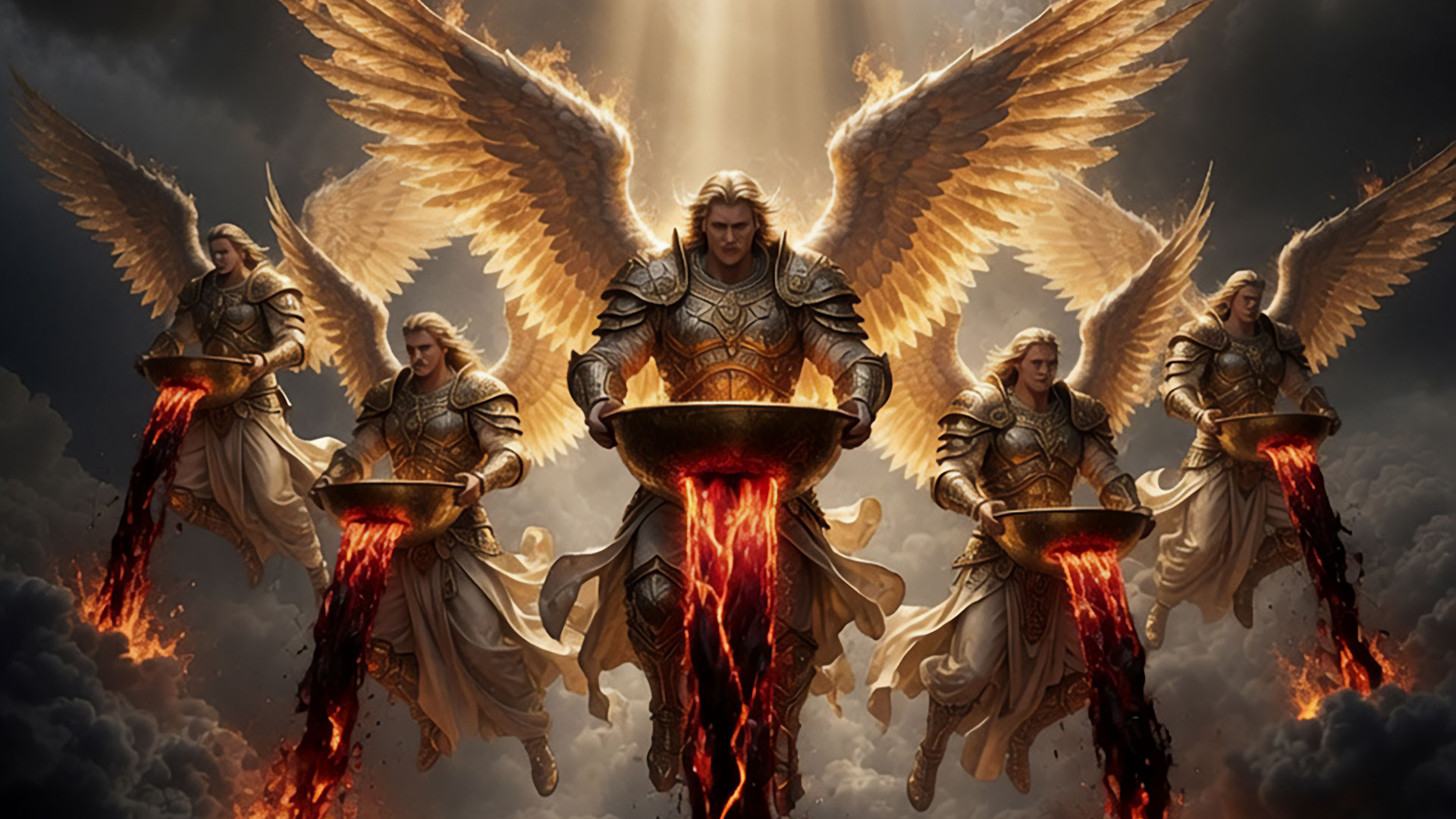
Sixth – four angelic horsemen are released to lead an army of 200 million to slay one-third of mankind with fire and smoke and brimstone.
Seventh – this trumpet heralds the coming “kingdom of our Lord and of His Christ; and He will reign forever and ever” (Revelation 11:15); this declaration leads to worship and rejoicing in Heaven, but portends another final round of wrath that will soon befall the earth.
Any rational person would long to be delivered from such an onslaught of suffering. Yet Scripture is clear: even kings and great men and commanders and rich and strong and every slave—in other words, every person who continues to reject Jesus Christ—will recognize that they are being subjected to “the wrath of the Lamb” yet still refuse to repent and bend their knee to His Lordship (Revelation 6:15-17). At the end of chapter 9, John documents the same response: those who are not killed outright by the end of the sixth trumpet “did not repent of the works of their hands, so as not to worship demons… and they did not repent of their murders nor of their sorceries nor of their immorality nor of their thefts” (9:20-21).
Isn’t it telling that theft is listed among other seemingly more offensive sins. But how many people right now are robbing God of the praise and glory He rightly deserves? How many of us bury our talents rather than invest them wisely—robbing our Master of a rightful return on the resources and gifts He has loaned to us?
Habakkuk’s intercessory prayer, “O LORD… in wrath remember mercy” (3:2), has been proven over and over again. I almost envision God Almighty rolling His eyes as Habakkuk utters that prayer, as if He could have responded, “Who do you think I AM?” God had revealed His Name and His character to Moses: “The LORD, the LORD God, compassionate and gracious, slow to anger, and abounding in lovingkindness and truth; who keeps lovingkindness for thousands, who forgives iniquity, transgression and sin; yet He will by no means leave the guilty unpunished…” (Exodus 34:6-7).
The Tribulation represents the righteous, holy, and justified indignation of God against a wicked and rebellious world. His pouring out of wrath—His own wrath, and not that of another—will be a demonstration that He will not leave the guilty unpunished. But even in the midst of wrath, He does remember mercy.
Why Tribulation?
Many Christians are at a loss to explain the Tribulation to anyone who asks how a loving God could subject the world to the horrors described in Revelation. We have done such a good job emphasizing the love of God and His desire to seek the lost and forgive their sin that we have minimized His righteousness and holiness.
That is an admittedly hard juxtaposition to grasp. God is able to combine perfect love with a hatred for that which is evil. He can unleash divine wrath even as He offers mercy without cost. He is justifiably angry at sinners, yet offers them grace—His own favor that they cannot earn by merit or deed.
The Tribulation is the culminating period of human history, when these great paradoxes are on full display. So why the Tribulation? In short, the Tribulation occurs:
- To pour out the punishment deserved by a wicked and rebellious world. Just as God saw “the wickedness of man on the earth, and that every intent of the thoughts of his heart was only evil continually” in the days of Noah (grieving Him to the point of global destruction), God will finally say “Enough!” as the cup of man’s wickedness runs over.
- In accordance with the heart of God, to drive unrepentant rebels to the end of themselves, so that some will come to the end of themselves, repent, and embrace Jesus Christ as Savior and Lord. Think Jonah and the Prodigal Son; both had to come to the end of themselves to repent and respond to the love of the Father.
- To drive stubborn and stiffnecked Israel to the end of itself, so that the remaining remnant of the Jewish people will look upon Him whom they have pierced, weep as over an only Son, and cry out, “Baruch haba b’Shem Adonai!” (Zechariah 12:10, John 19:37, and Matthew 23:39).
Unfortunately, there is much misunderstanding regarding the Tribulation. Here are a few of the mischaracterizations of this horrific period:
- The final purifying of the Church. Such an unbiblical attitude represents a form of purgatory (a thoroughly unbiblical idea) and negates the work of Christ on the Cross. Either there is “no condemnation” for those who are in Christ, OR His death was not sufficient to cover our sins.
- The Church will be tested during the Tribulation, demonstrating its ability to persevere. Jesus said He would rescue us from the wrath to come. Followers of Christ are subjected to ongoing trials and little-t tribulation (or “trouble”), but none will be subjected to the wrath of God; Jesus endured the full measure of wrath of His followers deserved at Calvary.
- God’s wrath will not be poured out until the mid-point of the Tribulation, or some other point later in the seven years. Jesus breaks the seals and unleashes the trumpets and bowls, and authorizes the various maladies that afflict the rebellious world, sans Church.
All said, there will be a great harvest of souls during the Tribulation. Many people will come to their senses and turn to Christ in believing faith. Many (if not most) of them will be martyred for their faith in that fraught time, but some will indeed endure to the end. Their belated acceptance of the Gospel will prove Billy Graham’s adage: “The same sun that melts the butter hardens the clay.” That truism contains the sad flip side of their belief: most people will suffer under the wrath of God and will harden their hearts instead of repent—just as we see evident in the world today.
The question remains: which response—and which eternal destiny—awaits you?
Hear Me Now or Believe Me Later
Some people, upon reading the binary decision presented to them, will choose to “wait and see.” By their logic, they’ll watch and see what happens to the Christians who are longing for Jesus to call them home. If their Christian friends and family members suddenly disappear, they rationalize that they’ll believe and trust in Christ then.
Here is the reason that is such a foolish gamble: No person is promised another day of life on this earth. Even as an ardent follower of Christ who longs to hear “the Lord Himself [descend] from Heaven with a shout, with the voice of the archangel and with the trumpet of God,” I may not live to experience that glorious moment in my mortal body. And, an unbeliever who thinks, “Once the Seal and Trumpet Judgments start falling, I’ll get serious about believing in Jesus,” may not live to see the Tribulation begin either. That is why Paul emphasized, “Behold, now is ‘the acceptable time,’ behold, now is ‘the day of salvation’…” (2 Corinthians 6:2).
So why do I end this article with the rhetorical either/or proposition, “Believe Me now or believe Me later”?
Because every person will believe in the Lord Jesus Christ at some point, every knee will bow, and every tongue will confess that Jesus Christ is Lord, to the glory of God the Father (Philippians 2:10-11). The demons already know Jesus Christ, but they refuse to accept His eternal authority and ultimate victory. Each of us must take God at His Word, accepting by faith His provision for salvation. It is that belief unto faith that sets us apart from the demonic hordes and those destined for Hell. Every person who rejects the Son in this lifetime will have a moment of horrible realization when they stand before the Judgment Seat of Christ, but then it will be too late.
So again, for all who are reading these words before the Tribulation, what trumpet awaits you—the trumpet calling you Heavenward or the trumpets that will blow as God’s wrath is poured out on you?
If you have ears to hear, I pray that you are eagerly awaiting the first.